what kind of growth model (pattern) is shown in the table?\n| x | y |\n| 1 | 5 |\n| 2 | 25 |\n| 3 | 125 |\n|…
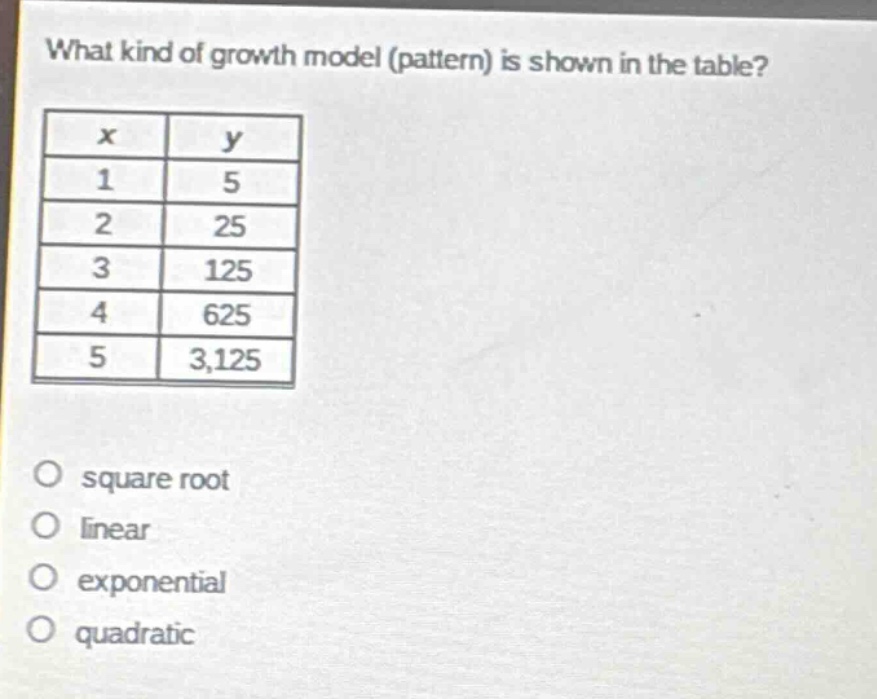
what kind of growth model (pattern) is shown in the table?\n| x | y |\n| 1 | 5 |\n| 2 | 25 |\n| 3 | 125 |\n| 4 | 625 |\n| 5 | 3,125 |\no square root\no linear\no exponential\no quadratic
Answer
Explanation:
Step1: Check for linearity
For a linear model, the difference in $y$-values for a constant change in $x$-values is constant. Here, when $x$ changes from 1 to 2, $y$ changes from 5 to 25 (a difference of 20), when $x$ changes from 2 to 3, $y$ changes from 25 to 125 (a difference of 100). Since the differences in $y$ are not constant, it's not linear.
Step2: Check for quadratic
For a quadratic model $y = ax^{2}+bx + c$, the second - differences of $y$ values are constant. Calculate first - differences: 20, 100, 500, 2500. Second - differences are not constant, so it's not quadratic.
Step3: Check for square - root
A square - root model has the form $y=a\sqrt{x}+b$. The values in the table do not follow this pattern.
Step4: Check for exponential
We can observe that $y = 5^{x}$. When $x = 1$, $y=5^{1}=5$; when $x = 2$, $y = 5^{2}=25$; when $x = 3$, $y=5^{3}=125$; when $x = 4$, $y=5^{4}=625$; when $x = 5$, $y=5^{5}=3125$. So it is an exponential model.
Answer:
exponential