a kite flying in the air has a 12 - ft line attached to it. its line is pulled taut and casts a 10 - ft…
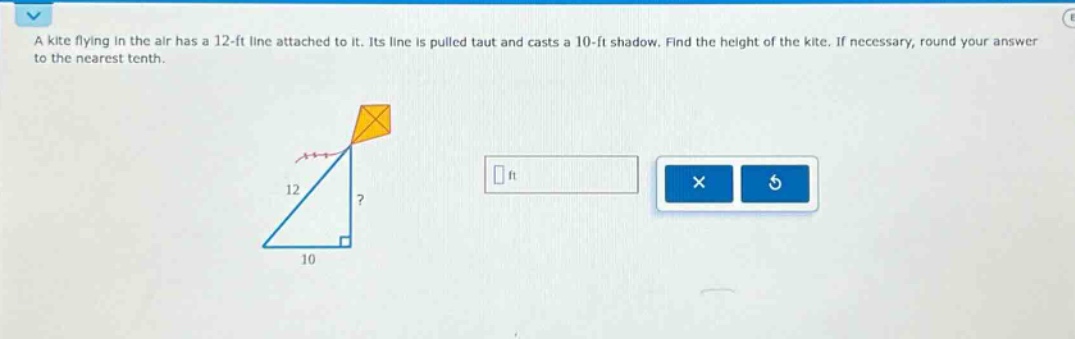
a kite flying in the air has a 12 - ft line attached to it. its line is pulled taut and casts a 10 - ft shadow. find the height of the kite. if necessary, round your answer to the nearest tenth.
Answer
Explanation:
Step1: Identify the right - triangle
The line of the kite, the height of the kite and the shadow form a right - triangle. The length of the kite line is the hypotenuse $c = 12$ ft and the length of the shadow is one of the legs $a = 10$ ft. We want to find the other leg $b$ (height of the kite).
Step2: Apply the Pythagorean theorem
The Pythagorean theorem is $a^{2}+b^{2}=c^{2}$. We can solve for $b$: $b=\sqrt{c^{2}-a^{2}}$. Substitute $a = 10$ and $c = 12$ into the formula: $b=\sqrt{12^{2}-10^{2}}=\sqrt{144 - 100}=\sqrt{44}$.
Step3: Calculate the value of $b$
$\sqrt{44}\approx6.6$ (rounded to the nearest tenth).
Answer:
$6.6$