kylie explained that (-4x + 9)^2 will result in a difference of squares because (-4x + 9)^2=(-4x)^2+(9)^2 =…
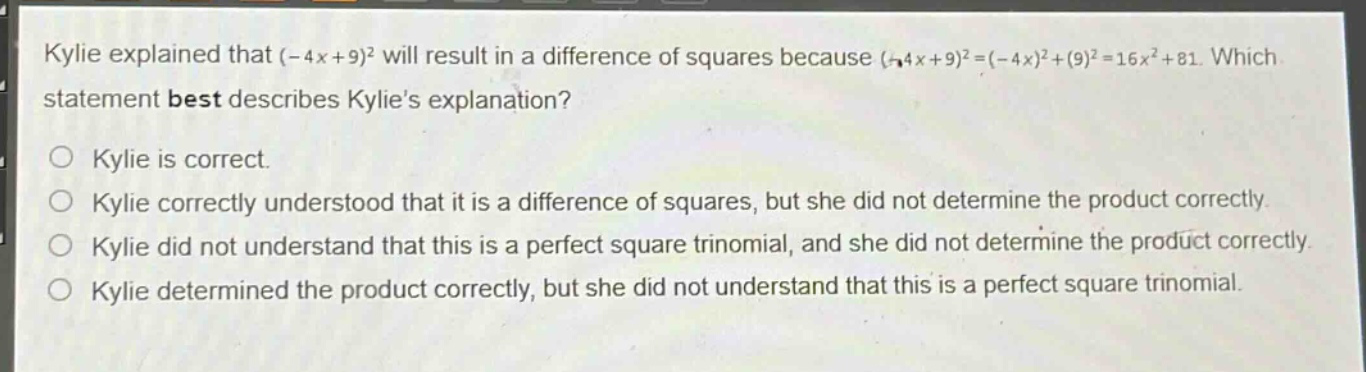
kylie explained that (-4x + 9)^2 will result in a difference of squares because (-4x + 9)^2=(-4x)^2+(9)^2 = 16x^2+81. which statement best describes kylies explanation?\no kylie is correct.\no kylie correctly understood that it is a difference of squares, but she did not determine the product correctly.\no kylie did not understand that this is a perfect square trinomial, and she did not determine the product correctly.\no kylie determined the product correctly, but she did not understand that this is a perfect square trinomial.
Answer
Explanation:
Step1: Recall the formula for perfect - square trinomial
The formula for ((a + b)^2=a^{2}+2ab + b^{2}). Here (a=-4x) and (b = 9), so ((-4x + 9)^2=(-4x)^{2}+2\times(-4x)\times9+9^{2}=16x^{2}-72x + 81).
Step2: Recall the formula for difference of squares
The formula for difference of squares is (a^{2}-b^{2}=(a + b)(a - b)). Kylie wrongly thought ((-4x + 9)^2=(-4x)^{2}+9^{2}), which is incorrect. Also, ((-4x + 9)^2) is a perfect - square trinomial, not a difference of squares.
Answer:
Kylie did not understand that this is a perfect square trinomial, and she did not determine the product correctly.