last week, lindsay earned $10 per hour plus a $60 bonus for good job performance. she spends $\frac{1}{15}$…
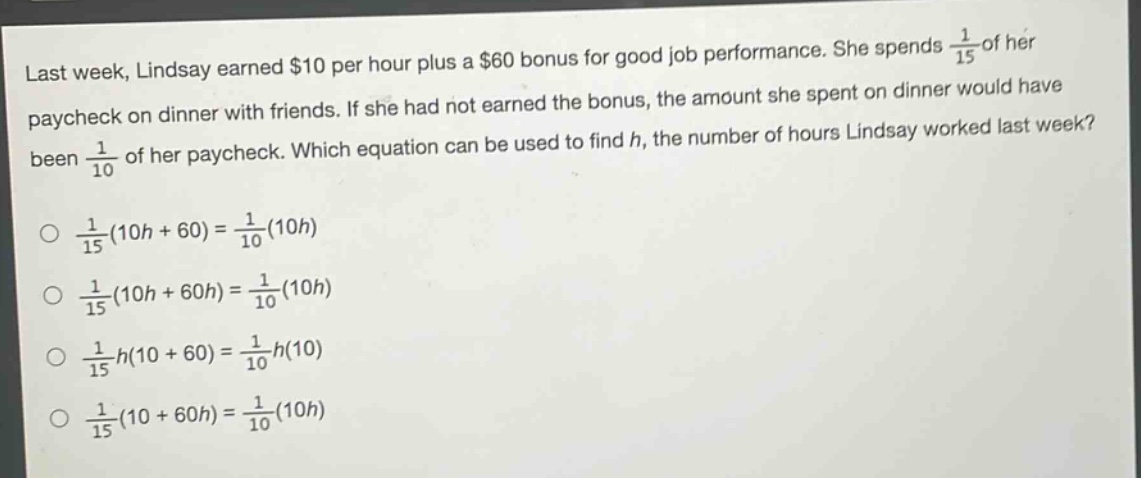
last week, lindsay earned $10 per hour plus a $60 bonus for good job performance. she spends $\frac{1}{15}$ of her paycheck on dinner with friends. if she had not earned the bonus, the amount she spent on dinner would have been $\frac{1}{10}$ of her paycheck. which equation can be used to find $h$, the number of hours lindsay worked last week?\n$\frac{1}{15}(10h + 60)=\frac{1}{10}(10h)$\n$\frac{1}{15}(10h + 60h)=\frac{1}{10}(10h)$\n$\frac{1}{15}h(10 + 60)=\frac{1}{10}h(10)$\n$\frac{1}{15}(10 + 60h)=\frac{1}{10}(10h)$
Answer
Explanation:
Step1: Calculate total paycheck with bonus
Lindsay earns $10 per hour, so for $h$ hours of work, she earns $10h$ dollars from hourly - rate. With a $60$ - dollar bonus, her total paycheck is $10h + 60$ dollars. She spends $\frac{1}{15}$ of this on dinner, so the amount spent on dinner is $\frac{1}{15}(10h + 60)$.
Step2: Calculate total paycheck without bonus
Without the bonus, her paycheck is just from her hourly - rate, which is $10h$ dollars. She would have spent $\frac{1}{10}$ of this on dinner, so the amount spent on dinner in this case is $\frac{1}{10}(10h)$.
Step3: Set up the equation
Since the amount spent on dinner is the same in both scenarios (the problem implies this relationship), we set up the equation $\frac{1}{15}(10h + 60)=\frac{1}{10}(10h)$.
Answer:
$\frac{1}{15}(10h + 60)=\frac{1}{10}(10h)$