y\\leq -x + 1\ny>x\n(-3, 5)\n(-2, 2)\n(-1, -3)\n(0, -1)
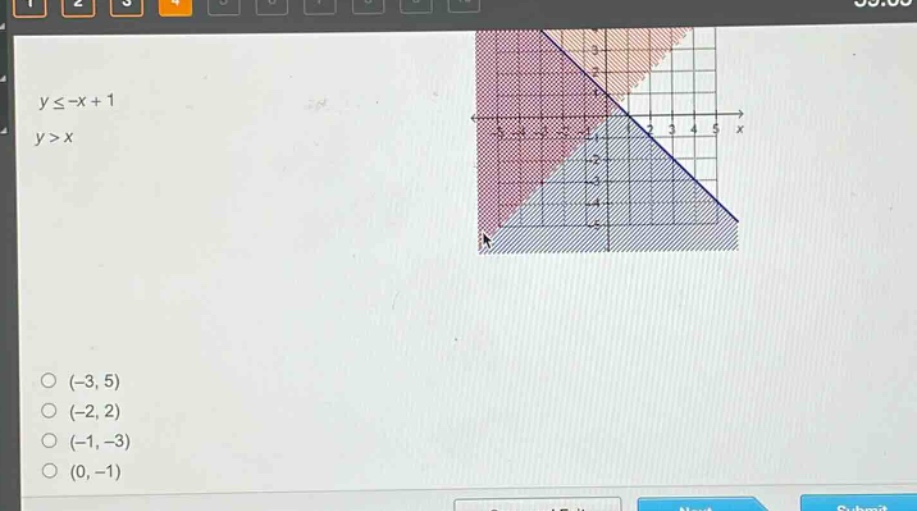
y\\leq -x + 1\ny>x\n(-3, 5)\n(-2, 2)\n(-1, -3)\n(0, -1)
Answer
Answer:
B. (-2, 2)
Explanation:
Step1: Check the first inequality for (-3, 5)
Substitute (x=-3,y = 5) into (y\leq -x + 1). We get (5\leq-(-3)+1=4), which is false.
Step2: Check the first inequality for (-2, 2)
Substitute (x = - 2,y=2) into (y\leq -x + 1). We have (2\leq-(-2)+1=3), which is true. Then substitute into (y>x), we get (2>-2), which is also true.
Step3: Check the first inequality for (-1, -3)
Substitute (x=-1,y=-3) into (y\leq -x + 1), we get (-3\leq-(-1)+1 = 2), which is true. But substitute into (y>x), we have (-3>-1), which is false.
Step4: Check the first inequality for (0, -1)
Substitute (x = 0,y=-1) into (y\leq -x + 1), we get (-1\leq-(0)+1=1), which is true. But substitute into (y>x), we have (-1>0), which is false.