let $mathbf{u}=overrightarrow{pq}$ be the directed line segment from $p(0,0)$ to $q(9,12)$, and let $c$ be a…
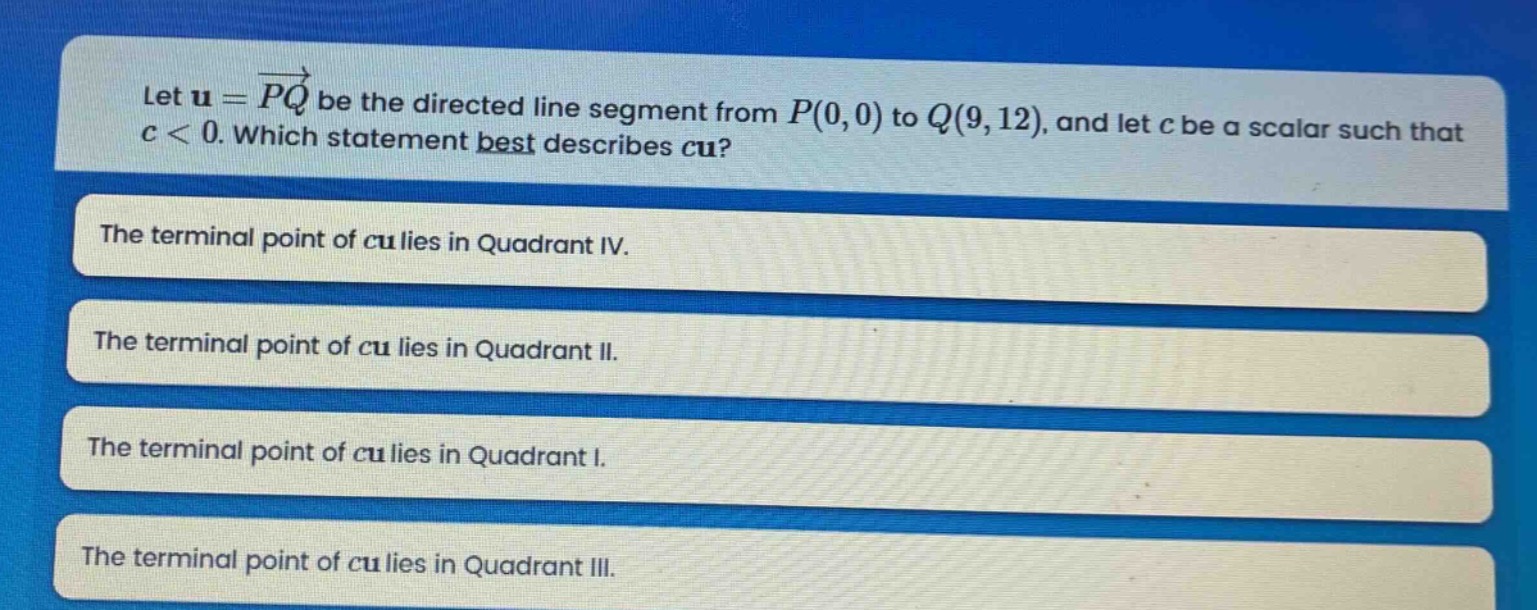
let $mathbf{u}=overrightarrow{pq}$ be the directed line segment from $p(0,0)$ to $q(9,12)$, and let $c$ be a scalar such that $c < 0$. which statement best describes $cmathbf{u}$?\nthe terminal point of $cmathbf{u}$ lies in quadrant iv.\nthe terminal point of $cmathbf{u}$ lies in quadrant ii.\nthe terminal point of $cmathbf{u}$ lies in quadrant i.\nthe terminal point of $cmathbf{u}$ lies in quadrant iii.
Answer
Explanation:
Step1: Find vector u
If (P(0,0)) and (Q(9,12)), then (\vec{u}=\overrightarrow{PQ}=\langle9 - 0,12 - 0\rangle=\langle9,12\rangle).
Step2: Multiply by scalar c
(c\vec{u}=c\langle9,12\rangle=\langle9c,12c\rangle). Since (c\lt0), then (9c\lt0) and (12c\lt0).
Answer:
The terminal point of (c\vec{u}) lies in Quadrant III.