lindsay is calculating the product of two consecutive odd integers. she says that the product is always…
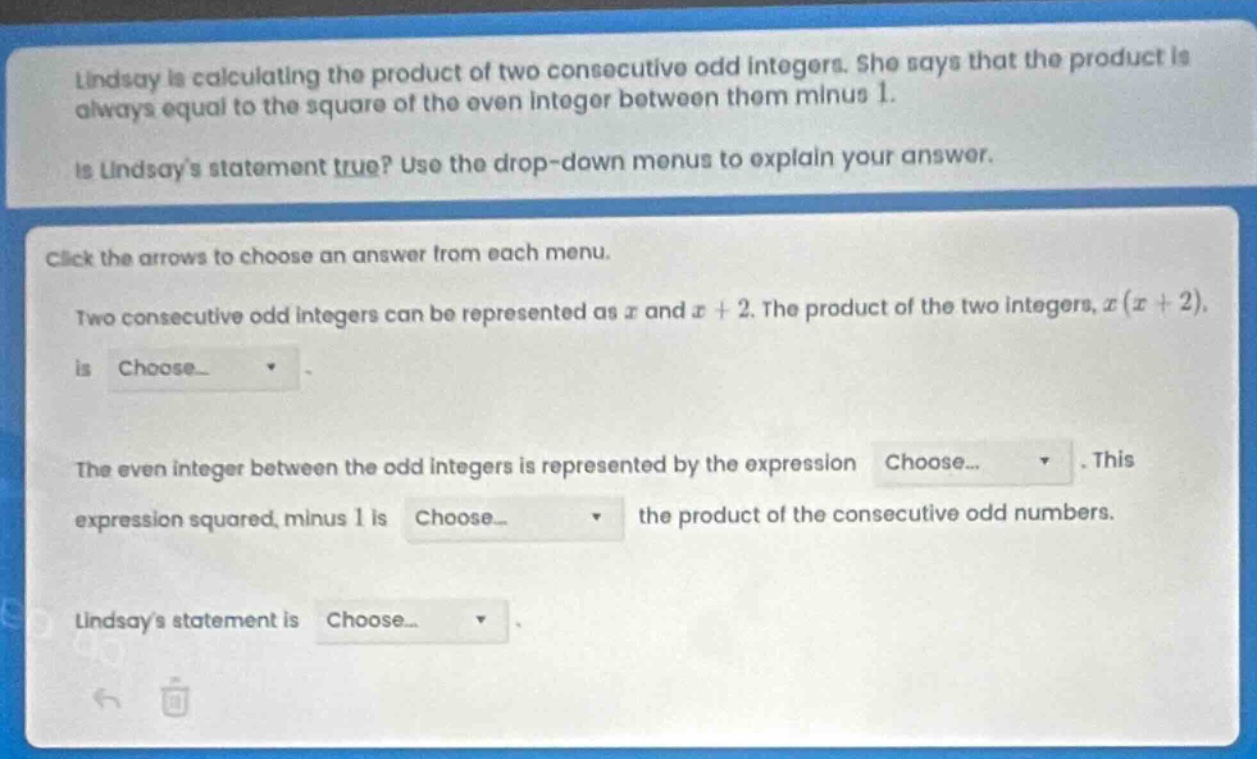
lindsay is calculating the product of two consecutive odd integers. she says that the product is always equal to the square of the even integer between them minus 1.\nis lindsays statement true? use the drop - down menus to explain your answer.\nclick the arrows to choose an answer from each menu.\ntwo consecutive odd integers can be represented as (x) and (x + 2). the product of the two integers, (x(x + 2)), is choose...\nthe even integer between the odd integers is represented by the expression choose... this expression squared, minus 1 is choose... the product of the consecutive odd numbers.\nlindsays statement is choose...
Answer
Answer:
- First blank: $x(x + 2)=x^{2}+2x$
- Second blank: $x + 1$
- Third blank: equal to
- Fourth blank: true
Explanation:
Step1: Expand product of odd - integers
Expand $x(x + 2)$ using distributive property: $x(x + 2)=x\times x+x\times2=x^{2}+2x$.
Step2: Find even - integer expression
The even integer between $x$ and $x + 2$ is $x+1$ (since if $x$ is odd, $x + 1$ is even).
Step3: Square and subtract 1
Square the even - integer expression and subtract 1: $(x + 1)^{2}-1$. Expand $(x + 1)^{2}$ using $(a + b)^{2}=a^{2}+2ab + b^{2}$, so $(x + 1)^{2}=x^{2}+2x + 1$. Then $(x + 1)^{2}-1=x^{2}+2x+1 - 1=x^{2}+2x$.
Step4: Compare expressions
Since $x(x + 2)=x^{2}+2x$ and $(x + 1)^{2}-1=x^{2}+2x$, Lindsay's statement is true.