a line is drawn through (-4, 3) and (4, 3). which describes whether or not the line represents a direct…
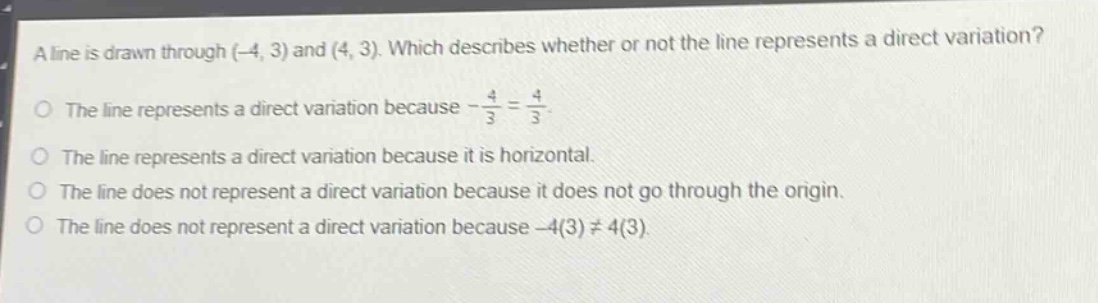
a line is drawn through (-4, 3) and (4, 3). which describes whether or not the line represents a direct variation?\nthe line represents a direct variation because -\\frac{4}{3}=\\frac{4}{3}.\nthe line represents a direct variation because it is horizontal.\nthe line does not represent a direct variation because it does not go through the origin.\nthe line does not represent a direct variation because -4(3)\\neq4(3).
Answer
Answer:
The line does not represent a direct variation because it does not go through the origin.
Explanation:
Step1: Recall direct - variation definition
A direct variation is of the form $y = kx$, which passes through the origin $(0,0)$.
Step2: Check if the given line passes through origin
The line passes through $(-4,3)$ and $(4,3)$. Substituting $x = 0$ into the equation of a line passing through these points, we find that the line is $y = 3$ (since the $y$-coordinate is constant). It does not pass through $(0,0)$. So it is not a direct - variation.