line segment jl is an altitude in triangle jkm. which statement explains whether jkm is a right triangle…
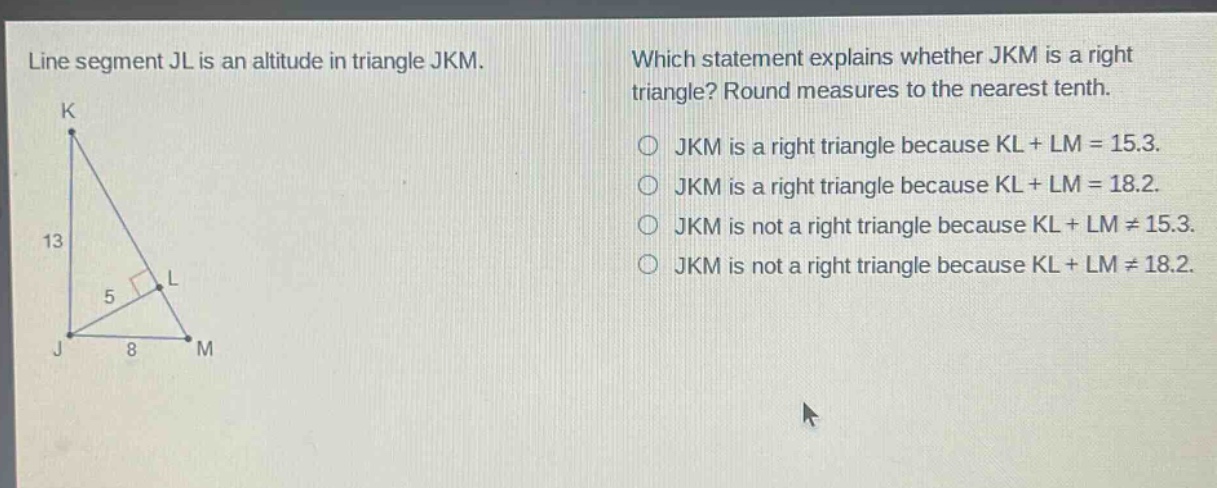
line segment jl is an altitude in triangle jkm. which statement explains whether jkm is a right triangle? round measures to the nearest tenth. jkm is a right triangle because kl + lm = 15.3. jkm is a right triangle because kl + lm = 18.2. jkm is not a right triangle because kl + lm ≠ 15.3. jkm is not a right triangle because kl + lm ≠ 18.2.
Answer
Explanation:
Step1: Use the geometric - mean theorem
In right - triangle (JKL), by the Pythagorean theorem, (KL=\sqrt{JK^{2}-JL^{2}}). Given (JK = 13) and (JL = 5), then (KL=\sqrt{13^{2}-5^{2}}=\sqrt{169 - 25}=\sqrt{144}=12).
Step2: In right - triangle (JLM), find (LM)
In right - triangle (JLM), by the Pythagorean theorem, (LM=\sqrt{JM^{2}-JL^{2}}). Given (JM = 8) and (JL = 5), then (LM=\sqrt{8^{2}-5^{2}}=\sqrt{64 - 25}=\sqrt{39}\approx6.2).
Step3: Calculate (KL + LM)
(KL+LM=12 + 6.2=18.2).
Step4: Apply the converse of the Pythagorean theorem
If (\triangle JKM) is a right - triangle with right - angle at (J), then by the geometric - mean theorem, (JL^{2}=KL\times LM) and also, if we consider the sides of (\triangle JKM), if (JK^{2}+JM^{2}=KM^{2}), and (KM=KL + LM). Here, (JK = 13), (JM = 8), and (KM=KL + LM). If (KM=18.2), (JK^{2}+JM^{2}=13^{2}+8^{2}=169 + 64=233), and (KM^{2}=18.2^{2}=331.24), (JK^{2}+JM^{2}\neq KM^{2}).
Answer:
JKM is not a right triangle because KL + LM ≠ 18.2.