which linear equality will not have a shared solution set with the graphed linear inequality?\n$y >…
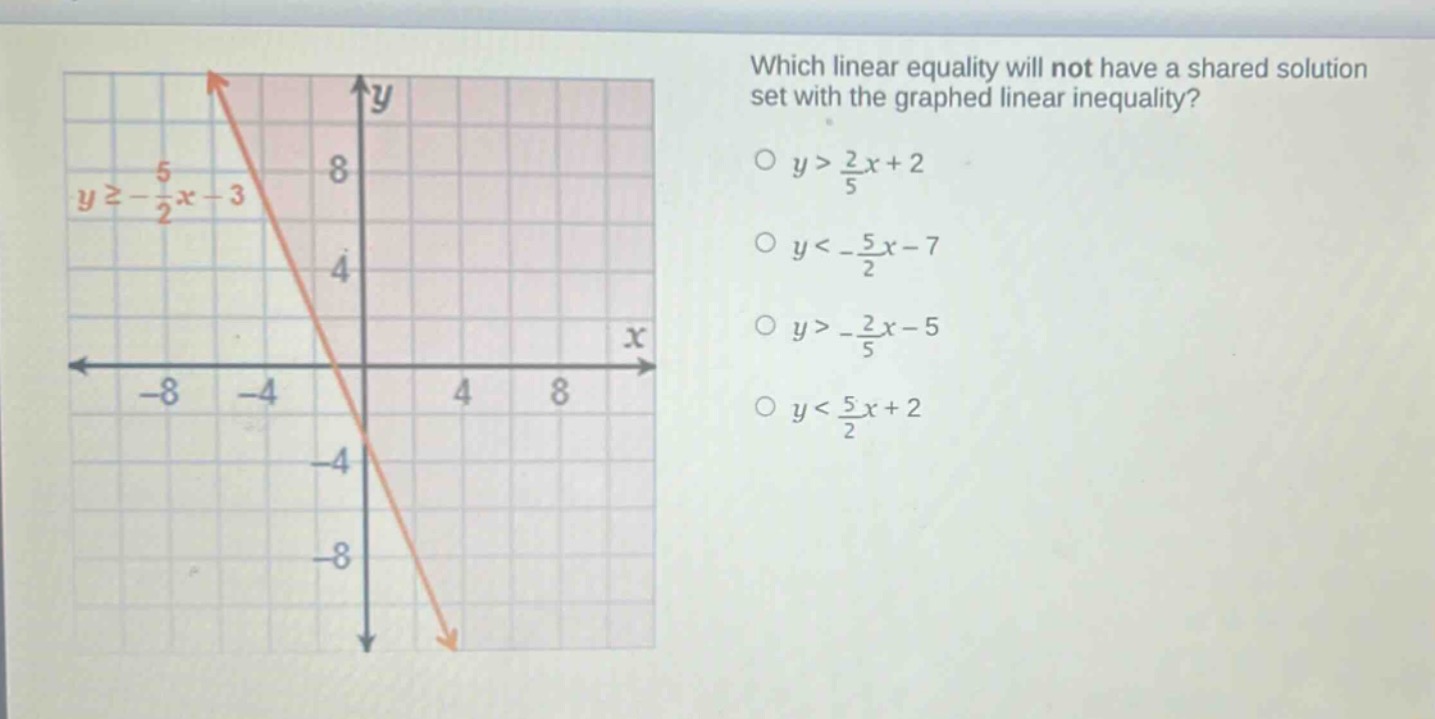
which linear equality will not have a shared solution set with the graphed linear inequality?\n$y > \\frac{2}{5}x + 2$\n$y < -\\frac{5}{2}x - 7$\n$y > -\\frac{2}{5}x - 5$\n$y < \\frac{5}{2}x + 2$\n$y\\geq -\\frac{5}{2}x - 3$
Answer
Explanation:
Step1: Analyze the slope - intercept form
The given inequality is $y\geq-\frac{5}{2}x - 3$, its slope $m_1=-\frac{5}{2}$ and y - intercept $b_1=-3$. Lines with the same slope are parallel. Parallel lines with non - overlapping shaded regions will not have a shared solution set.
Step2: Check each option's slope
- Option 1: $y>\frac{2}{5}x + 2$, slope $m=\frac{2}{5}$.
- Option 2: $y<-\frac{5}{2}x-7$, slope $m = -\frac{5}{2}$. This line is parallel to $y\geq-\frac{5}{2}x - 3$. Also, since the inequality $y<-\frac{5}{2}x-7$ has a different y - intercept and the shading is in the opposite sense (the given $y\geq-\frac{5}{2}x - 3$ has shading above the line and $y<-\frac{5}{2}x-7$ has shading below the line), they will not have a shared solution set.
- Option 3: $y>-\frac{2}{5}x - 5$, slope $m=-\frac{2}{5}$.
- Option 4: $y<\frac{5}{2}x + 2$, slope $m=\frac{5}{2}$.
Answer:
$y<-\frac{5}{2}x - 7$