linear functions a and b are represented by the table and graph shown. which statement is true about the…
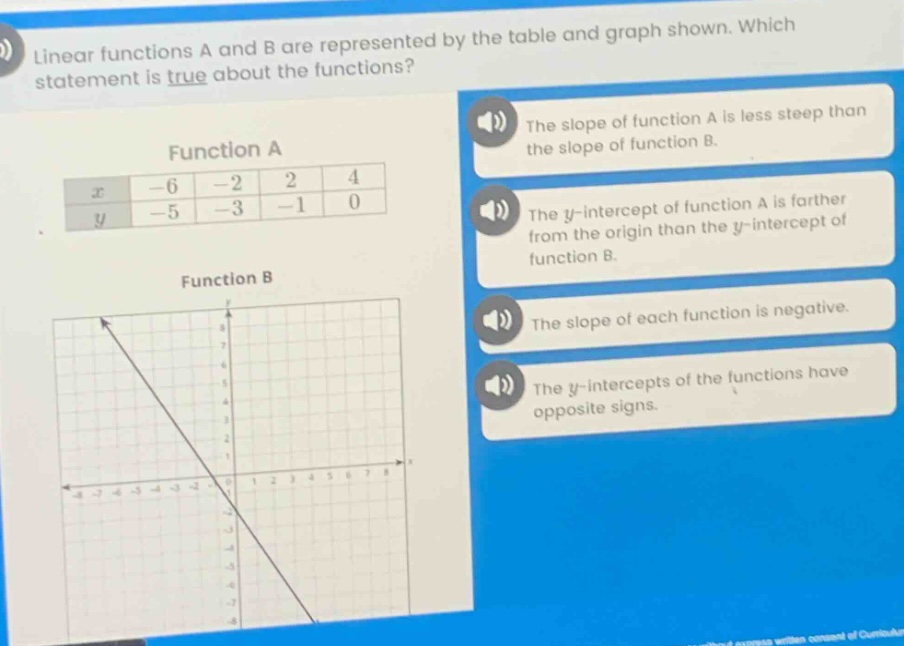
linear functions a and b are represented by the table and graph shown. which statement is true about the functions? function a x -6 -2 2 4 y -5 -3 -1 0 function b the slope of function a is less steep than the slope of function b. the y - intercept of function a is farther from the origin than the y - intercept of function b. the slope of each function is negative. the y - intercepts of the functions have opposite signs.
Answer
Explanation:
Step1: Find slope of function A
Use slope - formula $m=\frac{y_2 - y_1}{x_2 - x_1}$. Let $(x_1,y_1)=(-6,-5)$ and $(x_2,y_2)=(-2,-3)$. Then $m_A=\frac{-3-(-5)}{-2 - (-6)}=\frac{-3 + 5}{-2+6}=\frac{2}{4}=\frac{1}{2}$.
Step2: Find y - intercept of function A
Use point - slope form $y - y_1=m(x - x_1)$ with point $(4,0)$ and $m=\frac{1}{2}$. $y-0=\frac{1}{2}(x - 4)$, $y=\frac{1}{2}x-2$, so $y$-intercept of function A is $b_A=-2$.
Step3: Analyze function B from graph
The line of function B has a negative slope. It crosses the $y$-axis at a positive value, say $b_B = 2$ (by estimating from the graph). And the slope $m_B<0$.
Step4: Check each statement
- For the slope comparison: $|m_A|=\frac{1}{2}$ and $|m_B|> \frac{1}{2}$ (since function B is steeper), so the slope of function A is less steep than the slope of function B.
- For y - intercepts: $|b_A| = 2$ and $|b_B|=2$, they are not farther from the origin relative to each other.
- The slope of function A is positive ($m_A=\frac{1}{2}$), so the statement "The slope of each function is negative" is false.
- The $y$-intercepts of function A is $-2$ and of function B is positive, but they do not have opposite signs in the sense of being non - zero and of opposite signs in a way that one is a large positive and the other a large negative value relevant to the context, and the first statement about slopes is more accurate.