which linear inequality is graphed with y > -x - 2 to create the given solution set?\no y>x + 1\no y<x…
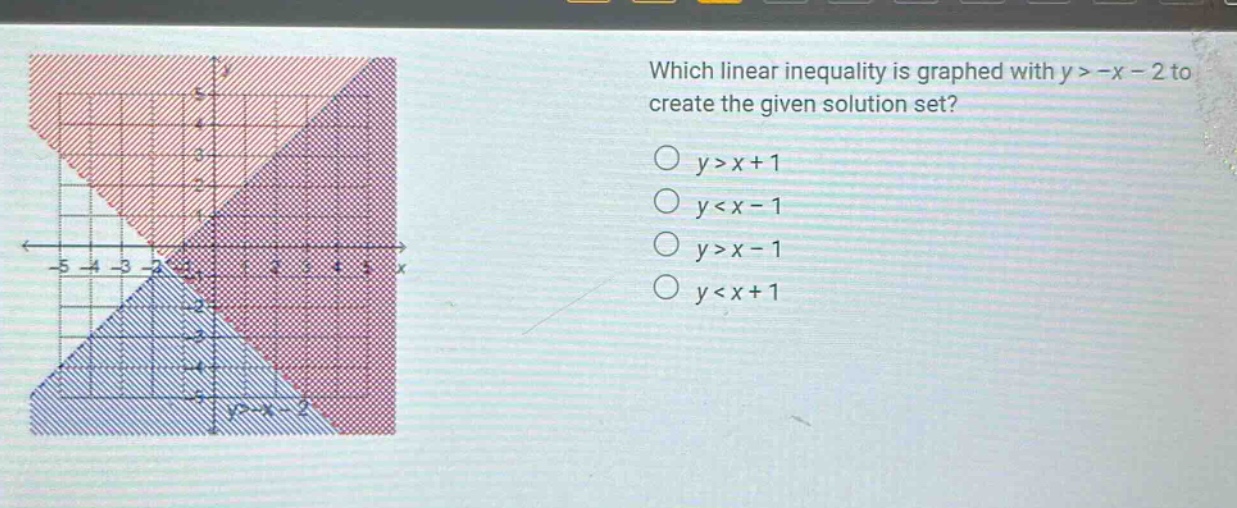
which linear inequality is graphed with y > -x - 2 to create the given solution set?\no y>x + 1\no y<x - 1\no y>x - 1\no y<x + 1
Answer
Explanation:
Step1: Analyze the intersection point
The intersection of the lines seems to be around the point ((- \frac{1}{2},-\frac{3}{2})). We can test the inequalities by substituting this point into the options.
Step2: Substitute into option A
For (y>x + 1), when (x=-\frac{1}{2}) and (y =-\frac{3}{2}), we have (-\frac{3}{2}>-\frac{1}{2}+1), i.e., (-\frac{3}{2}>\frac{1}{2}), which is false.
Step3: Substitute into option B
For (y<x - 1), when (x =-\frac{1}{2}) and (y=-\frac{3}{2}), we have (-\frac{3}{2}<-\frac{1}{2}-1), i.e., (-\frac{3}{2}<-\frac{3}{2}), which is false.
Step4: Substitute into option C
For (y>x - 1), when (x=-\frac{1}{2}) and (y =-\frac{3}{2}), we have (-\frac{3}{2}>-\frac{1}{2}-1), i.e., (-\frac{3}{2}>-\frac{3}{2}), which is false.
Step5: Substitute into option D
For (y<x + 1), when (x=-\frac{1}{2}) and (y=-\frac{3}{2}), we have (-\frac{3}{2}<-\frac{1}{2}+1), i.e., (-\frac{3}{2}<\frac{1}{2}), which is true. Also, by looking at the shading of the graph, the region below the line (y=x + 1) and above (y=-x - 2) matches the given solution - set.
Answer:
D. (y<x + 1)