which linear inequality is represented by the graph?\n$y>\frac{2}{3}x - 2$\n$y<\frac{2}{3}x +…
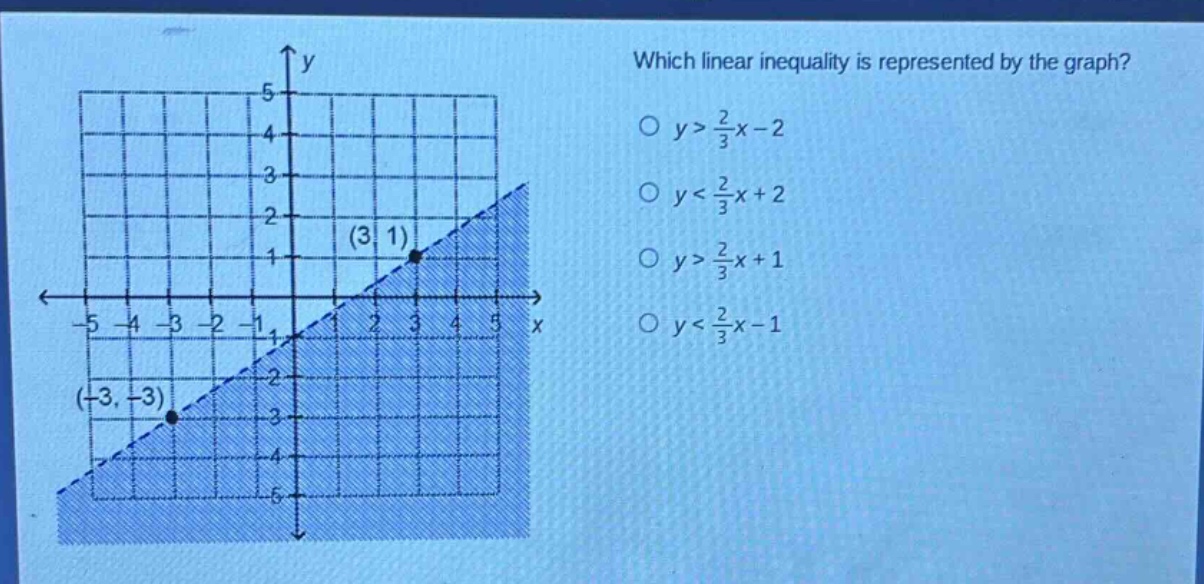
which linear inequality is represented by the graph?\n$y>\frac{2}{3}x - 2$\n$y<\frac{2}{3}x + 2$\n$y>\frac{2}{3}x + 1$\n$y<\frac{2}{3}x - 1$
Answer
Explanation:
Step1: Find the slope of the line
The slope $m$ of a line passing through two points $(x_1,y_1)$ and $(x_2,y_2)$ is given by $m=\frac{y_2 - y_1}{x_2 - x_1}$. Using the points $(-3,-3)$ and $(3,1)$, we have $m=\frac{1-(-3)}{3 - (-3)}=\frac{4}{6}=\frac{2}{3}$.
Step2: Find the y - intercept
The equation of a line in slope - intercept form is $y=mx + b$. Substitute $m = \frac{2}{3}$ and the point $(3,1)$ into the equation: $1=\frac{2}{3}\times3 + b$. Simplify the right - hand side: $1 = 2 + b$, so $b=-1$. The equation of the line is $y=\frac{2}{3}x - 1$.
Step3: Determine the inequality
The line is dashed, so the inequality is either $y>\frac{2}{3}x - 1$ or $y<\frac{2}{3}x - 1$. We test a point in the shaded region, say $(0,0)$. Substitute $x = 0$ and $y = 0$ into the inequalities. For $y>\frac{2}{3}x - 1$, we have $0>\frac{2}{3}\times0-1$, which is $0>-1$ (true). For $y<\frac{2}{3}x - 1$, we have $0<\frac{2}{3}\times0 - 1$, which is $0<-1$ (false).
Answer:
$y>\frac{2}{3}x - 2$ is incorrect. $y<\frac{2}{3}x + 2$ is incorrect. $y>\frac{2}{3}x + 1$ is incorrect. $y<\frac{2}{3}x - 1$ is incorrect. The correct answer is $y>\frac{2}{3}x - 1$.