which linear inequality is represented by the graph?\n$yleq\frac{1}{3}x - 1.3$\n$yleq\frac{1}{3}x-\frac{4}{3}…
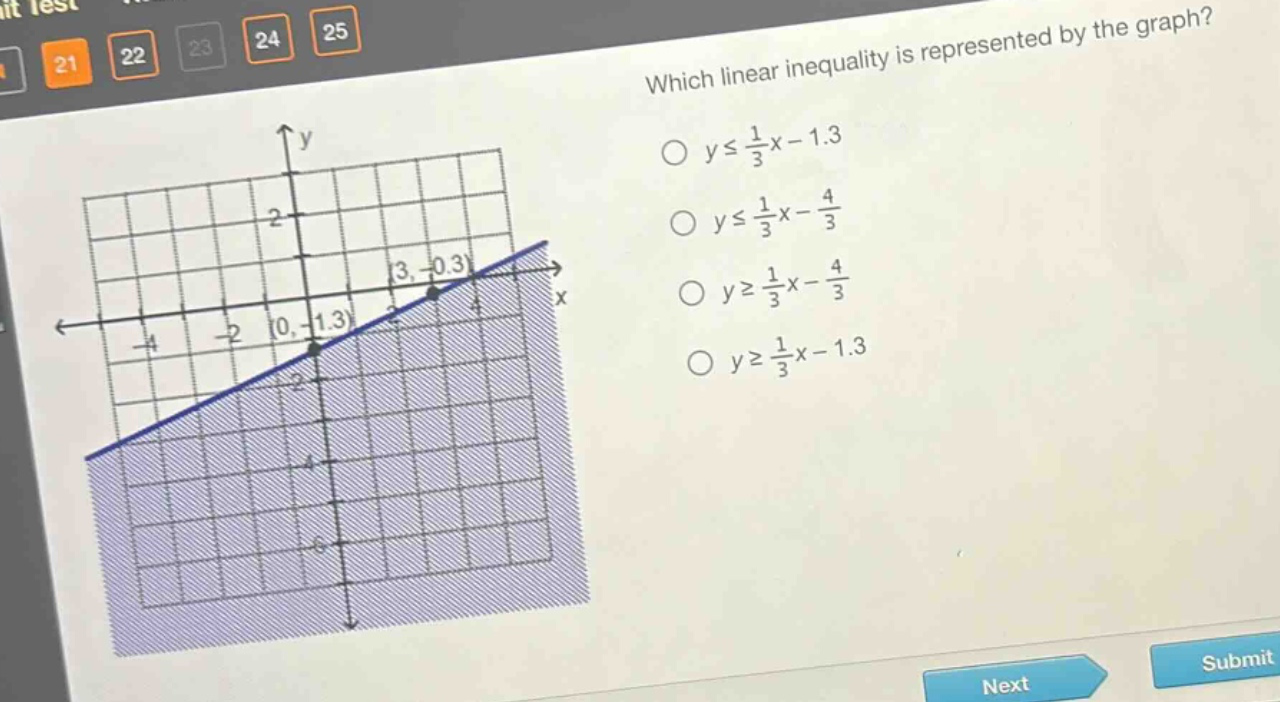
which linear inequality is represented by the graph?\n$yleq\frac{1}{3}x - 1.3$\n$yleq\frac{1}{3}x-\frac{4}{3}$\n$ygeq\frac{1}{3}x-\frac{4}{3}$\n$ygeq\frac{1}{3}x - 1.3$
Answer
Explanation:
Step1: Find the slope - intercept form of the line
The slope - intercept form of a line is $y = mx + b$, where $m$ is the slope and $b$ is the y - intercept. The line passes through the points $(0,-1.3)$ and $(3, - 0.3)$. The slope $m=\frac{y_2 - y_1}{x_2 - x_1}=\frac{-0.3-(-1.3)}{3 - 0}=\frac{-0.3 + 1.3}{3}=\frac{1}{3}$. The y - intercept $b=-1.3$ since the line crosses the y - axis at the point $(0,-1.3)$. So the equation of the line is $y=\frac{1}{3}x-1.3$.
Step2: Determine the inequality
The shaded region is below the line, and the line is solid. For a line $y = mx + b$, when the shaded region is below the line and the line is solid, the inequality is $y\leq mx + b$. So the linear inequality is $y\leq\frac{1}{3}x-1.3$.
Answer:
$y\leq\frac{1}{3}x - 1.3$ (corresponding to the first option)