lines c and d are parallel lines cut by transversal p. which must be true by the corresponding angles…
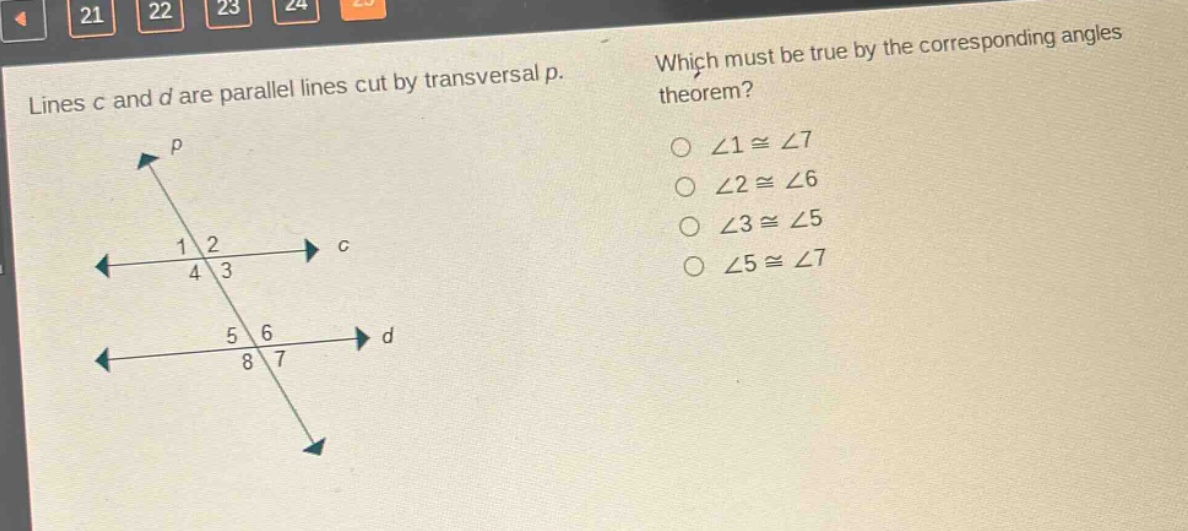
lines c and d are parallel lines cut by transversal p. which must be true by the corresponding angles theorem? ∠1≅∠7 ∠2≅∠6 ∠3≅∠5 ∠5≅∠7
Answer
Explanation:
Step1: Recall corresponding - angles theorem
When two parallel lines are cut by a transversal, corresponding angles are congruent. Corresponding angles are in the same relative position at each intersection.
Step2: Identify corresponding - angle pairs
For parallel lines (c) and (d) cut by transversal (p), (\angle2) and (\angle6) are corresponding angles. (\angle1) and (\angle5) are corresponding angles, (\angle3) and (\angle7) are corresponding angles, (\angle4) and (\angle8) are corresponding angles.
Answer:
(\angle2\cong\angle6)