lines b and c are parallel. what is the measure of ∠2? m∠2 = 31° m∠2 = 50° m∠2 = 120° m∠2 = 130° (7x + 1)°…
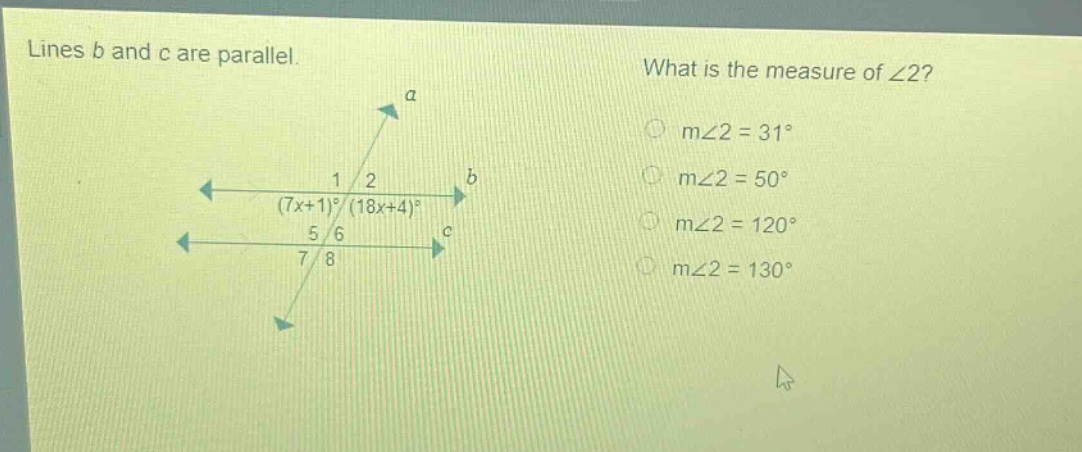
lines b and c are parallel. what is the measure of ∠2? m∠2 = 31° m∠2 = 50° m∠2 = 120° m∠2 = 130° (7x + 1)° (18x + 4)°
Answer
Explanation:
Step1: Use corresponding - angles property
Since lines (b) and (c) are parallel, (\angle1=(7x + 1)^{\circ}) and (\angle6=(18x + 4)^{\circ}) are corresponding angles, so (7x+1=18x + 4).
Step2: Solve the equation for (x)
[ \begin{align*} 7x+1&=18x + 4\ 7x-18x&=4 - 1\
- 11x&=3\ x&=-\frac{3}{11} \end{align*} ] This is incorrect. We should use the fact that (\angle1) and (\angle2) are a linear - pair. Also, since (b\parallel c), (\angle1) and (\angle6) are corresponding angles. And (\angle1+\angle2 = 180^{\circ}). Also, (\angle1=(7x + 1)^{\circ}) and (\angle2=(18x + 4)^{\circ}), so ((7x + 1)+(18x+4)=180).
Step3: Simplify the equation
[ \begin{align*} 7x+1+18x + 4&=180\ 25x+5&=180\ 25x&=180 - 5\ 25x&=175 \end{align*} ]
Step4: Solve for (x)
[x=\frac{175}{25}=7]
Step5: Find the measure of (\angle2)
Substitute (x = 7) into the expression for (\angle2): (\angle2=(18x + 4)^{\circ}). Then (\angle2=18\times7+4=126 + 4=130^{\circ}).
Answer:
(m\angle2 = 130^{\circ})