liz has $16 to spend at the book fair. each book costs $4. the table shows the relationship between the…
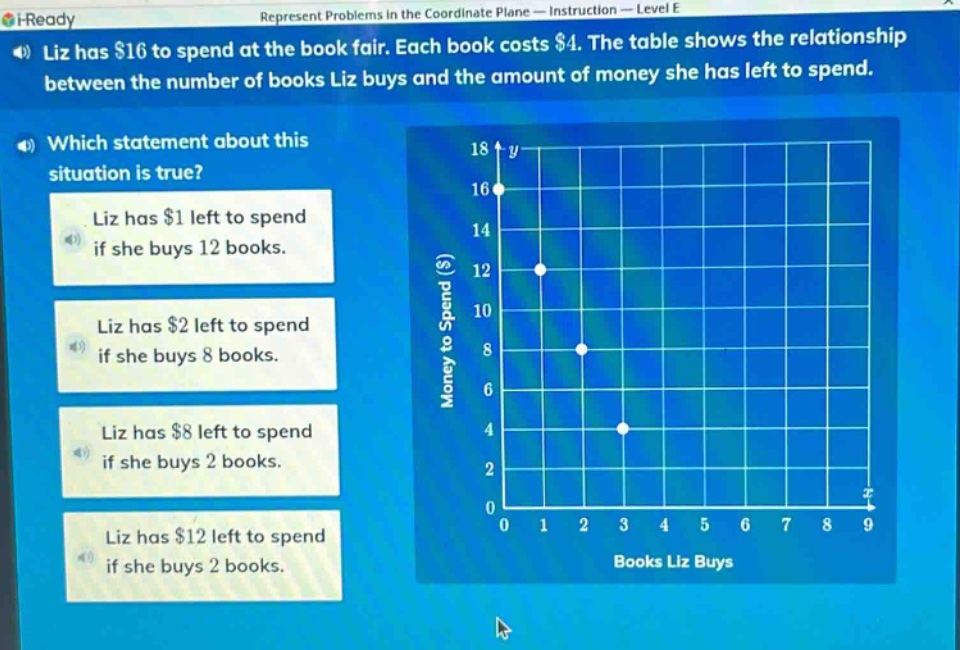
liz has $16 to spend at the book fair. each book costs $4. the table shows the relationship between the number of books liz buys and the amount of money she has left to spend. which statement about this situation is true? liz has $1 left to spend if she buys 12 books. liz has $2 left to spend if she buys 8 books. liz has $8 left to spend if she buys 2 books. liz has $12 left to spend if she buys 2 books.
Answer
Explanation:
Step1: Calculate cost of books
The cost of each book is $4. If Liz buys $n$ books, the total cost $C = 4n$.
Step2: Calculate money left
Liz starts with $16. The money left $M=16 - 4n$.
Step3: Check each option
- Option 1: If $n = 12$, $C=4\times12 = 48>16$, not possible.
- Option 2: If $n = 8$, $C = 4\times8=32>16$, not possible.
- Option 3: If $n = 2$, $C=4\times2 = 8$, $M=16 - 8=8$.
- Option 4: If $n = 2$, $C = 4\times2=8$, $M=16 - 8 = 8\neq12$.
Answer:
Liz has $8 left to spend if she buys 2 books.