the longest side of an acute isosceles triangle is 8 centimeters. rounded to the nearest tenth, what is the…
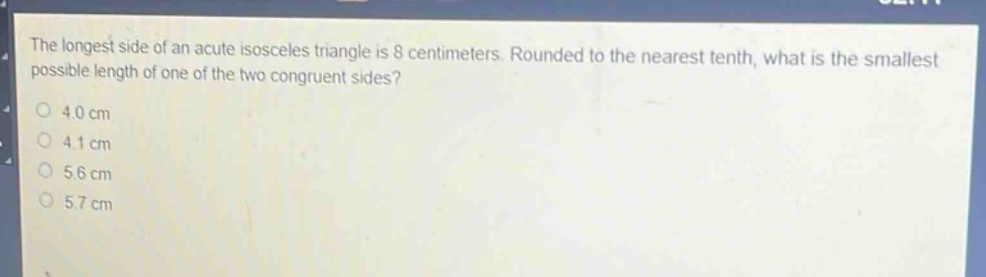
the longest side of an acute isosceles triangle is 8 centimeters. rounded to the nearest tenth, what is the smallest possible length of one of the two congruent sides?\n4.0 cm\n4.1 cm\n5.6 cm\n5.7 cm
Answer
Explanation:
Step1: Recall the cosine - law for an isosceles triangle
Let the length of the congruent sides be (a) and the length of the base be (b = 8). By the cosine - law, (\cos\theta=\frac{a^{2}+a^{2}-b^{2}}{2a\cdot a}=\frac{2a^{2}-b^{2}}{2a^{2}}), where (\theta) is the angle opposite the base. For an acute - angled triangle, all angles are less than (90^{\circ}), and (\cos\theta>0).
Step2: Set up the inequality from the cosine - law
Since (\cos\theta=\frac{2a^{2}-b^{2}}{2a^{2}}>0) and (b = 8), we have (2a^{2}-b^{2}>0). Substitute (b = 8) into the inequality: (2a^{2}-64>0).
Step3: Solve the inequality for (a)
First, add 64 to both sides of the inequality (2a^{2}-64>0) to get (2a^{2}>64). Then divide both sides by 2: (a^{2}>32). Take the square root of both sides. Since (a>0), we have (a > \sqrt{32}).
Step4: Calculate the value of (\sqrt{32}) and round
We know that (\sqrt{32}=\sqrt{16\times2}=4\sqrt{2}\approx4\times1.414 = 5.656). Rounding to the nearest tenth, (a\approx5.7).
Answer:
D. (5.7\ cm)