look at the graphs and their equations below. then fill in the information about the leading coefficients a…
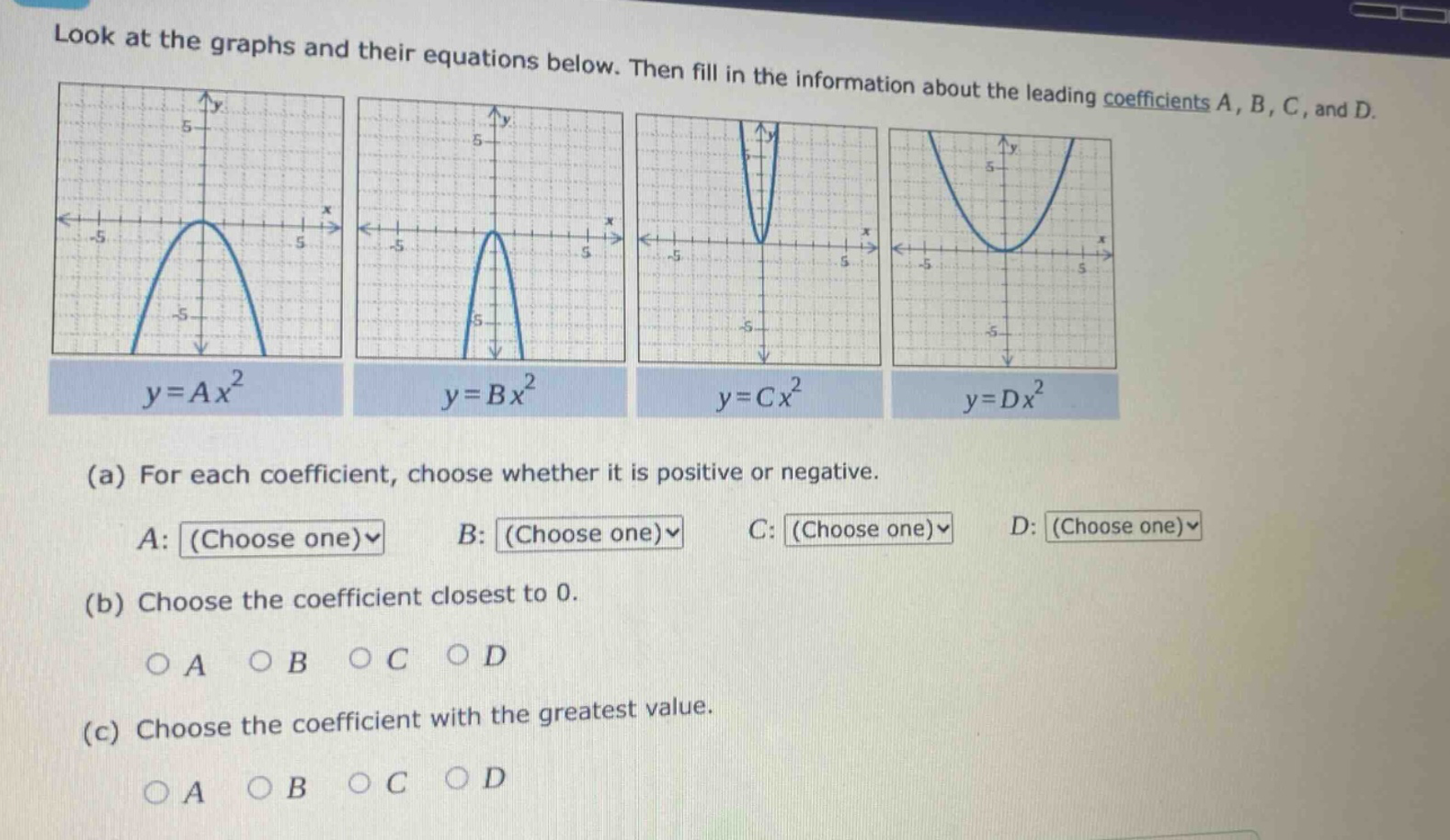
look at the graphs and their equations below. then fill in the information about the leading coefficients a, b, c, and d.\n(a) for each coefficient, choose whether it is positive or negative.\na: (choose one) b: (choose one) c: (choose one) d: (choose one)\n(b) choose the coefficient closest to 0.\no a o b o c o d\n(c) choose the coefficient with the greatest value.\no a o b o c o d
Answer
Explanation:
Step1: Determine sign of coefficients
For a quadratic function $y = ax^{2}$, if the parabola opens up, $a>0$; if it opens down, $a < 0$. The first two parabolas open down, so $A<0$ and $B < 0$. The last two parabolas open up, so $C>0$ and $D>0$.
Step2: Analyze magnitude based on width
The magnitude of the coefficient $a$ in $y = ax^{2}$ affects the width of the parabola. The larger the $|a|$, the narrower the parabola. The parabola $y = Ax^{2}$ is wider among the negative - coefficient parabolas and $y = Dx^{2}$ is wider among the positive - coefficient parabolas. A wider parabola means a smaller $|a|$. So $A$ is closest to 0.
Step3: Compare positive coefficients
Since $C$ and $D$ are positive, and the parabola $y = Cx^{2}$ is narrower than $y = Dx^{2}$, we know that $C>D$. So $C$ has the greatest value among all coefficients.
Answer:
(a) A: Negative, B: Negative, C: Positive, D: Positive (b) A (c) C