lorena solved the equation 5k - 3(2k - \\frac{2}{3}) - 9 = 0. her steps are below. 1. 5k - 6k + 2 - 9 = 0 2…
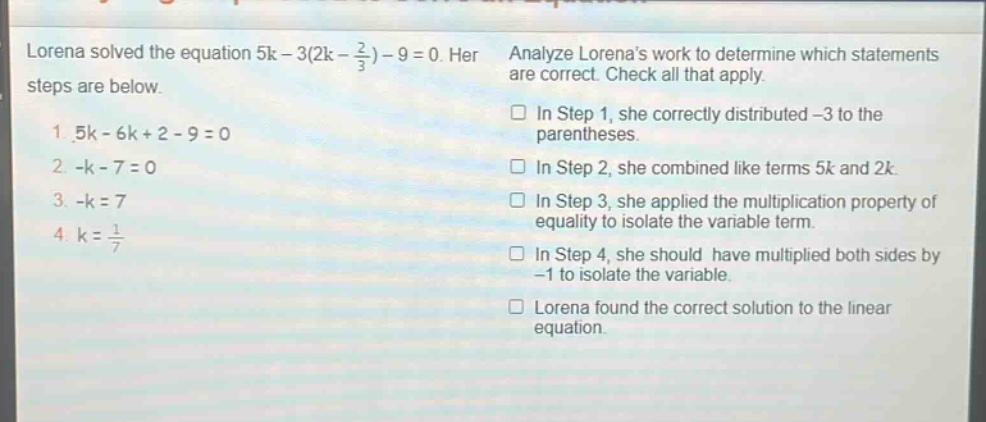
lorena solved the equation 5k - 3(2k - \\frac{2}{3}) - 9 = 0. her steps are below. 1. 5k - 6k + 2 - 9 = 0 2. -k - 7 = 0 3. -k = 7 4. k = \\frac{1}{7} analyze lorenas work to determine which statements are correct. check all that apply. in step 1, she correctly distributed -3 to the parentheses. in step 2, she combined like terms 5k and 2k. in step 3, she applied the multiplication property of equality to isolate the variable term. in step 4, she should have multiplied both sides by -1 to isolate the variable. lorena found the correct solution to the linear equation.
Answer
Answer:
- In Step 1, she correctly distributed -3 to the parentheses.
- In Step 4, she should have multiplied both sides by -1 to isolate the variable.
Explanation:
Step1: Analyze Step 1
When distributing -3 in -3(2k - \frac{2}{3}), we get -3\times2k-3\times(-\frac{2}{3})=-6k + 2. So Step 1 is correct.
Step2: Analyze Step 2
In Step 2, she combined 5k and -6k (not 5k and 2k), getting -k - 7=0. So the statement about combining 5k and 2k is wrong.
Step3: Analyze Step 3
In Step 3, she added 7 to both sides of -k - 7 = 0 to get -k=7, which is an application of the addition - property of equality, not the multiplication - property of equality. So this statement is wrong.
Step4: Analyze Step 4
Starting from -k = 7, to isolate k, we multiply both sides by -1 to get k=-7, not k = \frac{1}{7}. So she should have multiplied both sides by -1 in Step 4.
Step5: Analyze the solution
Since k=-7 and she got k=\frac{1}{7}, she did not find the correct solution.