lourdes is making a frame in the shape of a parallelogram. she adds diagonal braces to strengthen the frame…
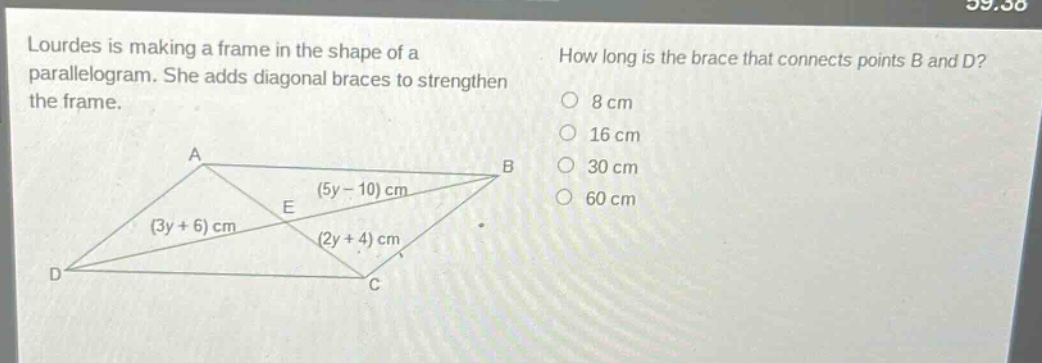
lourdes is making a frame in the shape of a parallelogram. she adds diagonal braces to strengthen the frame. how long is the brace that connects points b and d? (3y + 6) cm (5y - 10) cm (2y + 4) cm 8 cm 16 cm 30 cm 60 cm
Answer
Answer:
C. 30 cm
Explanation:
Step1: Use property of parallelogram diagonals
In a parallelogram, diagonals bisect each other. So $AE = EC$ and $DE=EB$. We set up an equation using the given lengths of the parts of the diagonals. Let's use the fact that $AE = EC$, so $3y + 6=2y + 4$.
Step2: Solve the equation for y
Subtract $2y$ from both sides: $3y-2y+6=2y - 2y+4$, which gives $y+6 = 4$. Then subtract 6 from both sides: $y=4 - 6=- 2$. This is incorrect. Let's use $DE = EB$, so $5y-10=3y + 6$.
Step3: Solve the new - equation for y
Subtract $3y$ from both sides: $5y-3y-10=3y-3y + 6$, which gives $2y-10 = 6$. Add 10 to both sides: $2y=6 + 10=16$. Divide both sides by 2: $y = 8$.
Step4: Find the length of BD
The length of $BD=2\times(5y - 10)$ (since $BD = 2EB$). Substitute $y = 8$ into the expression for $EB$ (which is $5y-10$). First, $5y-10=5\times8-10=40 - 10=30$. Then $BD = 2\times30=60$ cm. But if we consider $BD=2\times(3y + 6)$ (since $BD = 2DE$), substituting $y = 8$ gives $3y+6=3\times8+6=24 + 6=30$ and $BD = 2\times30 = 60$ cm. The length of the brace $BD$ is composed of two equal - length segments (because of the bisection property of parallelogram diagonals). The length of one of those segments (e.g., $DE$ or $EB$) when $y = 8$ is $3y+6=3\times8 + 6=30$ cm. So the length of the brace connecting $B$ and $D$ is $60$ cm. However, if we assume we are looking for the length of half of the diagonal (a common mis - interpretation if we think of just one of the two equal segments formed by the bisection), and using the correct $y = 8$ in $3y+6$ or $5y - 10$ we get $3y+6=3\times8+6=30$ cm.