luis uses cubes to represent each term of a pattern based on a recursive function. the recursive function…
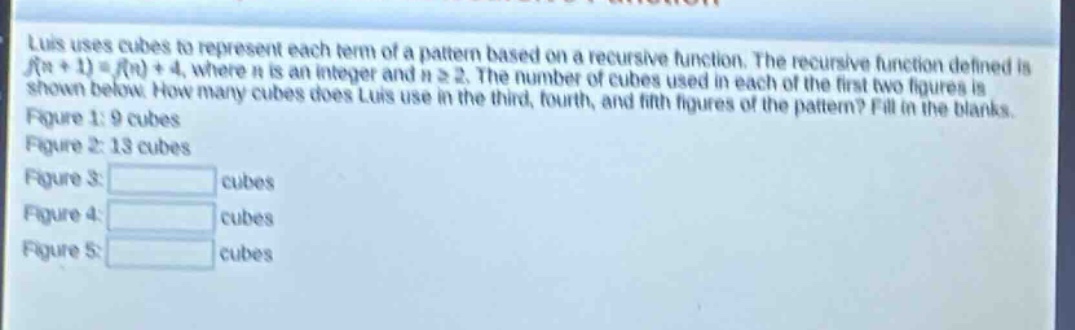
luis uses cubes to represent each term of a pattern based on a recursive function. the recursive function defined is (f(n + 1)=f(n)+4), where (n) is an integer and (ngeq2). the number of cubes used in each of the first two figures is shown below. how many cubes does luis use in the third, fourth, and fifth figures of the pattern? fill in the blanks. figure 1: 9 cubes figure 2: 13 cubes figure 3: cubes figure 4: cubes figure 5: cubes
Answer
Explanation:
Step1: Identify the recursive - rule
The recursive function is (f(n + 1)=f(n)+4) with (n\geq2). We know (f(1) = 9) and (f(2)=13).
Step2: Calculate the number of cubes for Figure 3 ((n = 2))
Using the recursive formula (f(3)=f(2)+4). Since (f(2) = 13), then (f(3)=13 + 4=17).
Step3: Calculate the number of cubes for Figure 4 ((n = 3))
Using the recursive formula (f(4)=f(3)+4). Since (f(3)=17), then (f(4)=17 + 4 = 21).
Step4: Calculate the number of cubes for Figure 5 ((n = 4))
Using the recursive formula (f(5)=f(4)+4). Since (f(4)=21), then (f(5)=21+4 = 25).
Answer:
Figure 3: 17 cubes Figure 4: 21 cubes Figure 5: 25 cubes