the magnitude and direction of two vectors are shown in the diagram. what is the magnitude of their sum?
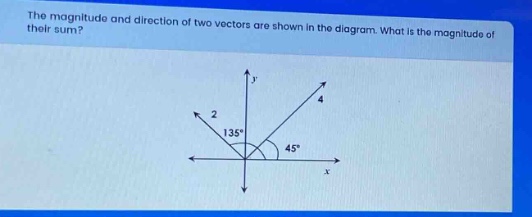
the magnitude and direction of two vectors are shown in the diagram. what is the magnitude of their sum?
Answer
Explanation:
Step1: Write vectors in component - form
For the vector with magnitude $A = 2$ and direction $\theta_1=135^{\circ}$, its components are $A_x = 2\cos135^{\circ}=2\times(-\frac{\sqrt{2}}{2})=-\sqrt{2}$ and $A_y = 2\sin135^{\circ}=2\times\frac{\sqrt{2}}{2}=\sqrt{2}$. For the vector with magnitude $B = 4$ and direction $\theta_2 = 45^{\circ}$, its components are $B_x=4\cos45^{\circ}=4\times\frac{\sqrt{2}}{2}=2\sqrt{2}$ and $B_y = 4\sin45^{\circ}=4\times\frac{\sqrt{2}}{2}=2\sqrt{2}$.
Step2: Find the components of the sum vector
The $x$ - component of the sum vector $\vec{R}$ is $R_x=A_x + B_x=-\sqrt{2}+2\sqrt{2}=\sqrt{2}$. The $y$ - component of the sum vector $\vec{R}$ is $R_y=A_y + B_y=\sqrt{2}+2\sqrt{2}=3\sqrt{2}$.
Step3: Calculate the magnitude of the sum vector
The magnitude of a vector $\vec{R}$ with components $(R_x,R_y)$ is given by $R=\sqrt{R_x^{2}+R_y^{2}}$. Substitute $R_x=\sqrt{2}$ and $R_y = 3\sqrt{2}$ into the formula: $R=\sqrt{(\sqrt{2})^{2}+(3\sqrt{2})^{2}}=\sqrt{2 + 18}=\sqrt{20}=2\sqrt{5}$.
Answer:
$2\sqrt{5}$