if (mangle a = mangle b) and (mangle a + mangle c = mangle d), then (mangle b + mangle c = mangle d). which…
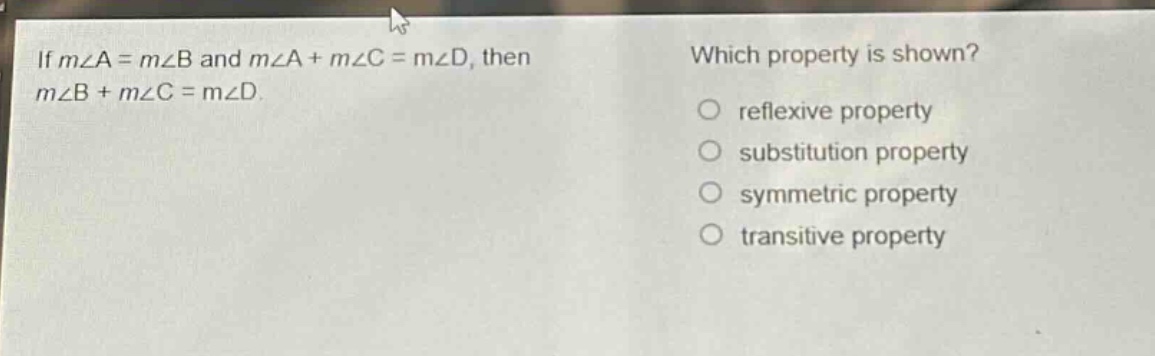
if (mangle a = mangle b) and (mangle a + mangle c = mangle d), then (mangle b + mangle c = mangle d). which property is shown? reflexive property substitution property symmetric property transitive property
Answer
Brief Explanations:
The substitution property states that if two quantities are equal, then one can be replaced for the other in any expression. Here, since (m\angle A=m\angle B), (m\angle A) in the equation (m\angle A + m\angle C=m\angle D) is replaced with (m\angle B).
Answer:
substitution property