how many extraneous solutions does the equation below have?\n$\frac{2m}{2m + 3}-\frac{2m}{2m…
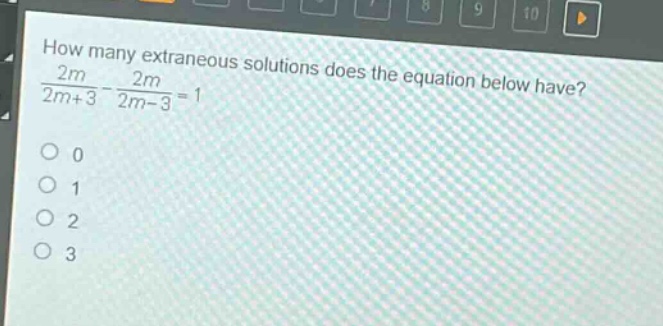
how many extraneous solutions does the equation below have?\n$\frac{2m}{2m + 3}-\frac{2m}{2m - 3}=1$\n0\n1\n2\n3
Answer
Explanation:
Step1: Find a common denominator
The common denominator of $2m + 3$ and $2m-3$ is $(2m + 3)(2m - 3)$. Rewrite the left - hand side of the equation: $\frac{2m(2m - 3)-2m(2m + 3)}{(2m + 3)(2m - 3)}=1$.
Step2: Expand the numerator
Expand $2m(2m - 3)-2m(2m + 3)$: [ \begin{align*} 2m(2m - 3)-2m(2m + 3)&=(4m^{2}-6m)-(4m^{2}+6m)\ &=4m^{2}-6m - 4m^{2}-6m\ &=-12m \end{align*} ] The denominator is $(2m + 3)(2m - 3)=4m^{2}-9$ by the difference - of - squares formula $(a + b)(a - b)=a^{2}-b^{2}$. So the equation becomes $\frac{-12m}{4m^{2}-9}=1$.
Step3: Cross - multiply
Cross - multiply to get $-12m=4m^{2}-9$. Rearrange it to the standard quadratic form $4m^{2}+12m - 9 = 0$.
Step4: Find the domain of the original equation
The original equation $\frac{2m}{2m + 3}-\frac{2m}{2m - 3}=1$ has restrictions $2m+3\neq0$ and $2m - 3\neq0$, i.e., $m\neq-\frac{3}{2}$ and $m\neq\frac{3}{2}$.
Step5: Solve the quadratic equation
For the quadratic equation $4m^{2}+12m - 9 = 0$, where $a = 4$, $b = 12$, $c=-9$. The quadratic formula is $m=\frac{-b\pm\sqrt{b^{2}-4ac}}{2a}$. [ \begin{align*} m&=\frac{-12\pm\sqrt{12^{2}-4\times4\times(-9)}}{2\times4}\ &=\frac{-12\pm\sqrt{144 + 144}}{8}\ &=\frac{-12\pm\sqrt{288}}{8}\ &=\frac{-12\pm12\sqrt{2}}{8}\ &=\frac{-3\pm3\sqrt{2}}{2} \end{align*} ] Neither $m=\frac{-3 + 3\sqrt{2}}{2}$ nor $m=\frac{-3-3\sqrt{2}}{2}$ makes the original denominators zero.
Answer:
0