how many extraneous solutions does the equation below have?\n\\(\\frac{9}{n^{2}+1}=\\frac{n +…
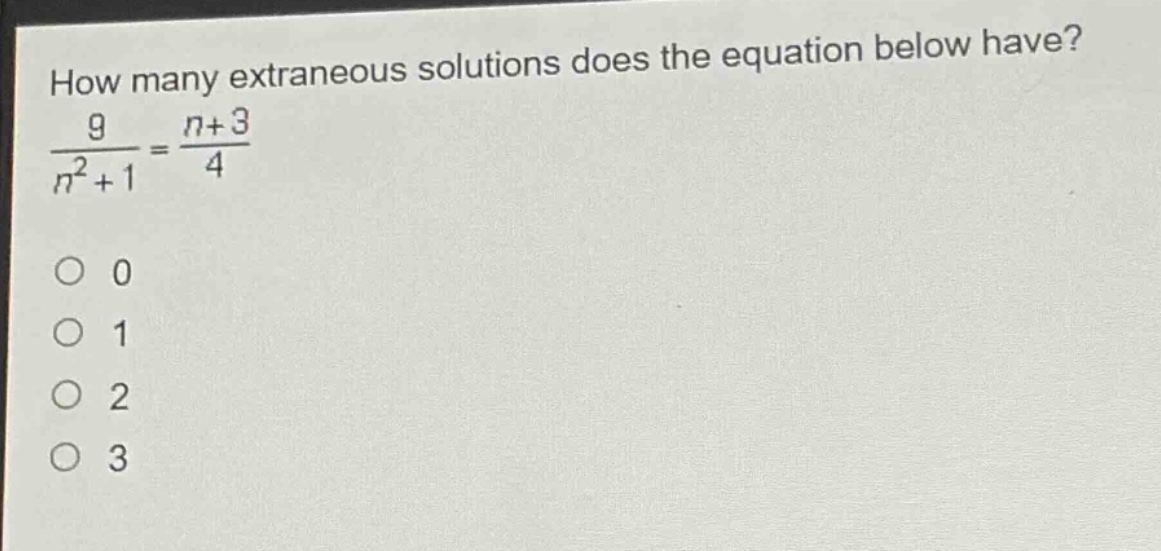
how many extraneous solutions does the equation below have?\n\\(\\frac{9}{n^{2}+1}=\\frac{n + 3}{4}\\)\n0\n1\n2\n3
Answer
Explanation:
Step1: Cross - multiply the equation
$9\times4=(n + 3)(n^{2}+1)$ $36=n^{3}+n+3n^{2}+3$ $n^{3}+3n^{2}+n - 33 = 0$ The denominator $n^{2}+1$ is never zero for real - valued $n$ since $n^{2}\geq0$ for all real $n$, so $n^{2}+1\geq1$ for all real $n$.
Step2: Analyze extraneous solutions
Since the original rational equation has a non - zero denominator for all real $n$ (the denominator $n^{2}+1$ is non - zero for all real $n$), there are no values of $n$ that make the original equation undefined when substituting the solutions of the resulting polynomial equation back into the original equation. So, there are 0 extraneous solutions.
Answer:
A. 0