how many solutions does this linear system have?\n$y = \\frac{2}{3}x + 2$\n$6x - 4y=-10$\none solution…
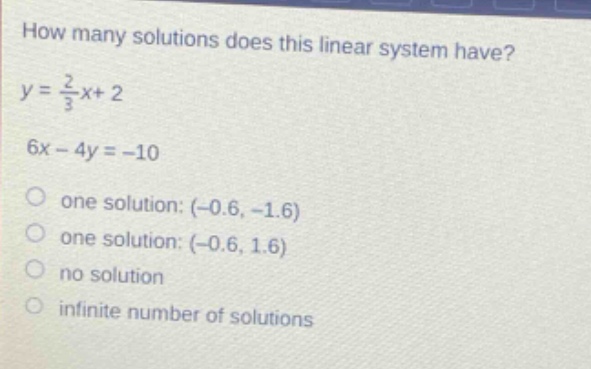
how many solutions does this linear system have?\n$y = \\frac{2}{3}x + 2$\n$6x - 4y=-10$\none solution: (-0.6, -1.6)\none solution: (-0.6, 1.6)\nno solution\ninfinite number of solutions
Answer
Explanation:
Step1: Rewrite the first - equation
The first equation is $y=\frac{2}{3}x + 2$, which can be rewritten as $2x-3y=-6$ (multiply through by 3 to get $3y = 2x+6$ and then rearrange).
Step2: Rewrite the second - equation
The second equation is $6x - 4y=-10$, which can be simplified by dividing through by 2 to get $3x-2y=-5$.
Step3: Check the slopes
For the line $2x - 3y=-6$, we can rewrite it in slope - intercept form $y=\frac{2}{3}x + 2$, so the slope $m_1=\frac{2}{3}$. For the line $3x-2y=-5$, we rewrite it as $y=\frac{3}{2}x+\frac{5}{2}$, so the slope $m_2=\frac{3}{2}$. Since $m_1\neq m_2$, the two lines intersect at a single point.
Step4: Solve the system (optional)
We can use the substitution method. Substitute $y=\frac{2}{3}x + 2$ into $6x-4y=-10$. $6x-4(\frac{2}{3}x + 2)=-10$. $6x-\frac{8}{3}x-8=-10$. $\frac{18x - 8x}{3}=-10 + 8$. $\frac{10x}{3}=-2$. $x=-0.6$. Substitute $x = - 0.6$ into $y=\frac{2}{3}x+2$, $y=\frac{2}{3}\times(-0.6)+2=-0.4 + 2=1.6$.
Answer:
one solution: $(-0.6,1.6)$