mattie uses the discriminant to determine the number of zeros the quadratic equation 0 = 3x² - 7x + 4 has…
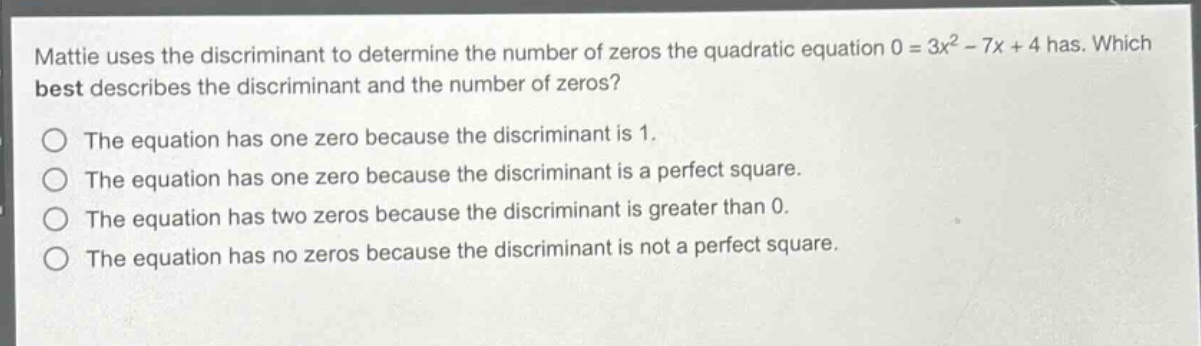
mattie uses the discriminant to determine the number of zeros the quadratic equation 0 = 3x² - 7x + 4 has. which best describes the discriminant and the number of zeros?\nthe equation has one zero because the discriminant is 1.\nthe equation has one zero because the discriminant is a perfect square.\nthe equation has two zeros because the discriminant is greater than 0.\nthe equation has no zeros because the discriminant is not a perfect square.
Answer
Explanation:
Step1: Identify coefficients
For the quadratic equation $ax^{2}+bx + c=0$, in $3x^{2}-7x + 4 = 0$, $a = 3$, $b=-7$, $c = 4$.
Step2: Calculate discriminant
The discriminant formula is $\Delta=b^{2}-4ac$. Substitute the values: $\Delta=(-7)^{2}-4\times3\times4=49 - 48=1$.
Step3: Determine number of zeros
Since $\Delta>0$ (here $\Delta = 1>0$), the quadratic - equation has two distinct real zeros.
Answer:
The equation has two zeros because the discriminant is greater than 0.