what is the maximum value of $p = 4x + 2y$, given the constraints on $x$ and $y$ listed below?\n$x +…
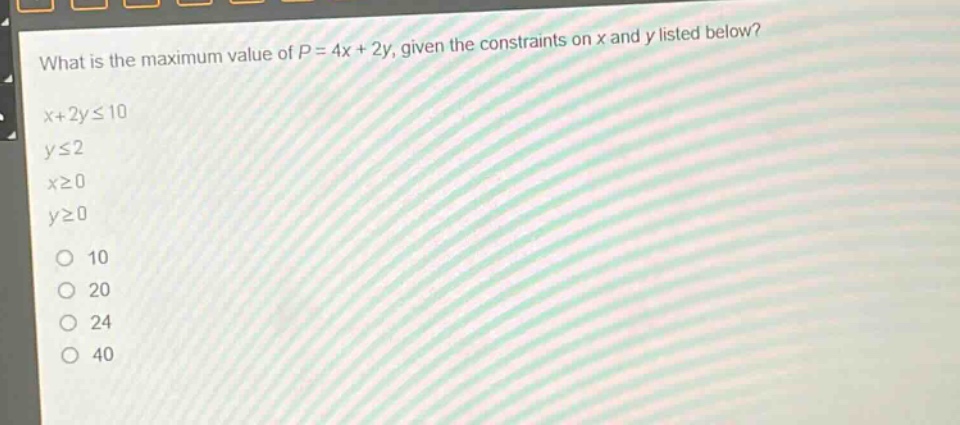
what is the maximum value of $p = 4x + 2y$, given the constraints on $x$ and $y$ listed below?\n$x + 2yleq10$\n$yleq2$\n$xgeq0$\n$ygeq0$\n10\n20\n24\n40
Answer
Explanation:
Step1: Find intersection points
- Intersection of (x + 2y=10) and (y = 2): Substitute (y = 2) into (x+2y=10), we get (x+2\times2=10), so (x=10 - 4=6). The point is ((6,2)).
- Intersection of (x + 2y=10) and (x = 0): Substitute (x = 0) into (x+2y=10), we get (2y=10), so (y = 5). The point is ((0,5)). But since (y\leq2), this intersection point is not in the feasible - region.
- Intersection of (x + 2y=10) and (y = 0): Substitute (y = 0) into (x+2y=10), we get (x=10). The point is ((10,0)).
- Intersection of (y = 2) and (x = 0): The point is ((0,2)).
- Intersection of (y = 2) and (y = 0) is not a valid intersection for the feasible - region.
- Intersection of (x = 0) and (y = 0): The point is ((0,0)).
Step2: Evaluate (P = 4x+2y) at intersection points
- At ((0,0)): (P=4\times0 + 2\times0=0).
- At ((0,2)): (P=4\times0+2\times2 = 4).
- At ((6,2)): (P=4\times6+2\times2=24 + 4=28).
- At ((10,0)): (P=4\times10+2\times0=40).
Answer:
40