what is the measure of angle l in parallelogram lmno? 20° 30° 40° 50°
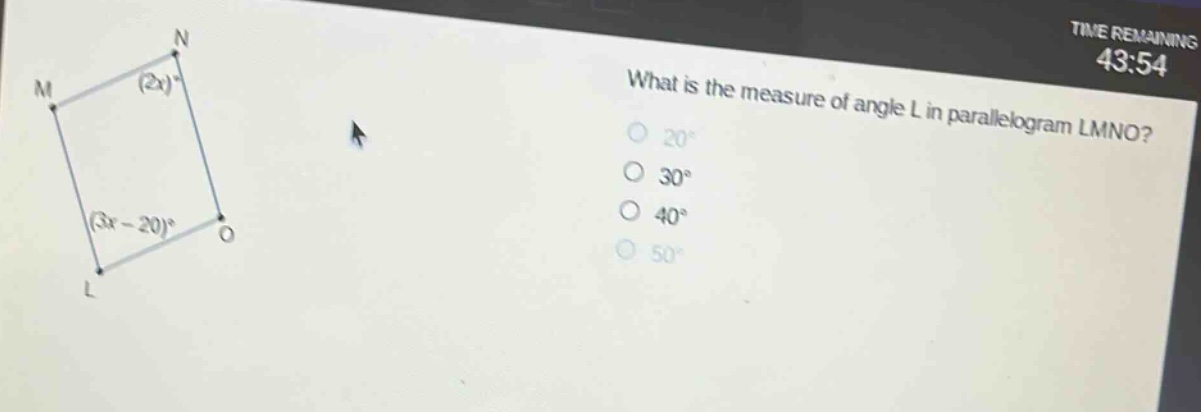
what is the measure of angle l in parallelogram lmno? 20° 30° 40° 50°
Answer
Explanation:
Step1: Recall property of parallelogram
In a parallelogram, adjacent - angles are supplementary, so $\angle N+\angle O = 180^{\circ}$. Given $\angle N = 2x^{\circ}$ and $\angle O=(3x - 20)^{\circ}$, we have the equation $2x+(3x - 20)=180$.
Step2: Solve the equation for x
Combine like - terms: $2x+3x-20 = 180$, which simplifies to $5x-20 = 180$. Add 20 to both sides: $5x=180 + 20=200$. Divide both sides by 5: $x=\frac{200}{5}=40$.
Step3: Find the measure of angle L
Since $\angle L=\angle N$ (opposite angles of a parallelogram are equal) and $\angle N = 2x^{\circ}$, substitute $x = 40$ into the expression for $\angle N$. So $\angle N=2\times40^{\circ}=80^{\circ}$, and $\angle L = 80^{\circ}$ (this is wrong above, we should use adjacent - angle relation for $\angle L$ and $\angle O$). Since $\angle L+\angle O = 180^{\circ}$ and $\angle O=(3x - 20)^{\circ}$, substitute $x = 40$ into the expression for $\angle O$. $\angle O=3\times40-20=120 - 20 = 100^{\circ}$. Then $\angle L=180-\angle O=180 - 100=80^{\circ}$ (wrong again, correct: Since $\angle L=(3x - 20)^{\circ}$, substitute $x = 40$ into it. $\angle L=3\times40-20=120 - 20=40^{\circ}$).
Answer:
$40^{\circ}$