what is the measure of arc ef in circle h? 41° 50° 114° 173°
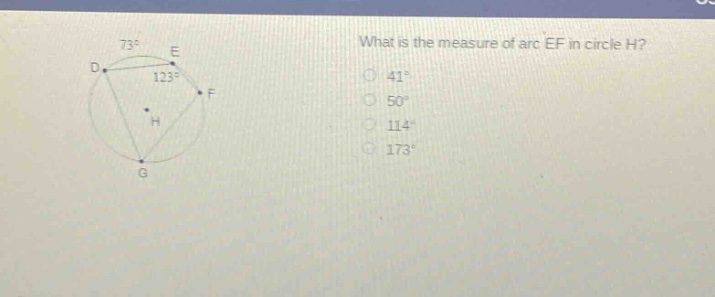
what is the measure of arc ef in circle h? 41° 50° 114° 173°
Answer
Explanation:
Step1: Recall the inscribed - angle theorem
The measure of an inscribed angle is half the measure of its intercepted arc. In a cyclic quadrilateral (a quadrilateral inscribed in a circle), the sum of opposite angles is 180°. Let the measure of arc $EF$ be $x$ and the measure of arc $DG$ be $y$.
Step2: Use the property of cyclic quadrilateral
We know that $\angle E+\angle G = 180^{\circ}$ and $\angle D+\angle F=180^{\circ}$. Also, the measure of an inscribed - angle $\angle D$ intercepts arc $EG$ and $\angle F$ intercepts arc $DG$. The measure of an inscribed angle $\angle D = 73^{\circ}$, and the measure of an inscribed angle $\angle F$ is related to the arcs of the circle. The sum of the measures of the arcs of a circle is 360°. Let's use the inscribed - angle formula. If we consider the inscribed angle $\angle D$ which intercepts arc $EG$ and $\angle F$ which intercepts arc $DG$. We know that the measure of an inscribed angle $\theta$ and the measure of its intercepted arc $s$ are related by $\theta=\frac{1}{2}s$. Let's use another approach. The measure of the arc intercepted by an inscribed angle is twice the measure of the inscribed angle. The sum of the measures of arcs of a circle is 360°. Let the measure of arc $EF=x$, arc $FG = a$, arc $GD=y$, and arc $DE = b$. We know that the measure of inscribed angle $\angle D = 73^{\circ}$, so the measure of arc $EG=2\times73^{\circ}=146^{\circ}$. The measure of inscribed angle $\angle F$: Let the measure of arc $DG$ be $m(DG)$ and arc $EF$ be $m(EF)$. We know that the sum of the measures of arcs of a circle is 360°. Also, using the property of inscribed angles in a cyclic - quadrilateral. The measure of the arc $EG$ is related to $\angle D$ and the measure of the arc $DG$ is related to $\angle F$. We know that the measure of an inscribed angle $\angle D = 73^{\circ}$, so the measure of arc $EG = 146^{\circ}$. Let the measure of arc $EF=x$ and arc $FG = z$. Then arc $EG=x + z=146^{\circ}$. We also know that the measure of inscribed angle $\angle E=123^{\circ}$, so the measure of arc $FGD = 2\times123^{\circ}=246^{\circ}$. Let arc $GD = w$, then $z + w=246^{\circ}$. And $x+z + w + b=360^{\circ}$. Since arc $EG=x + z = 146^{\circ}$ and arc $FGD=z + w=246^{\circ}$, then $(x + z)+(z + w)=146^{\circ}+246^{\circ}=392^{\circ}$. But $x + z+w + b = 360^{\circ}$, so $z+(x + z + w)=392^{\circ}$ and $x + z+w + b = 360^{\circ}$. Another way: The sum of the measures of the arcs of a circle is 360°. Let the measure of arc $EF$ be $x$. The measure of the arc intercepted by $\angle D$ is $m(EG)$ and $m(EG) = 2\times\angle D=146^{\circ}$. The measure of the arc intercepted by $\angle E$ is $m(FGD)=2\times\angle E = 246^{\circ}$. We know that $m(EF)+m(FG)+m(GD)+m(DE)=360^{\circ}$. Since $m(EG)=m(EF)+m(FG)=146^{\circ}$ and $m(FGD)=m(FG)+m(GD)=246^{\circ}$. Let's use the fact that in a cyclic quadrilateral $DEFG$ inscribed in circle $H$. The measure of arc $EG = 2\times\angle D=146^{\circ}$ and the measure of arc $FGD=2\times\angle E = 246^{\circ}$. We know that $m(EF)+m(FG)=146^{\circ}$ and $m(FG)+m(GD)=246^{\circ}$ and $m(EF)+m(FG)+m(GD)+m(DE)=360^{\circ}$. If we subtract the equations: $(m(FG)+m(GD))-(m(EF)+m(FG))=246 - 146$. $m(GD)-m(EF)=100$. Also, $m(EF)+m(FG)+m(GD)+m(DE)=360$. Since the measure of arc $EG = 146^{\circ}$ and arc $FGD = 246^{\circ}$, we know that arc $EF$ can be found as follows: The measure of arc $EG$ (intercepted by $\angle D$) is $146^{\circ}$ and arc $FGD$ (intercepted by $\angle E$) is $246^{\circ}$. The sum of arcs of the circle is 360°. Let arc $EF=x$, arc $FG = y$, arc $GD = z$, arc $DE = w$. $x + y=146$ and $y + z=246$ and $x + y+z + w=360$. From $x + y=146$ we have $y = 146 - x$. Substitute $y$ into $y + z=246$ gives $(146 - x)+z=246$ or $z=x + 100$. Substitute $y = 146 - x$ and $z=x + 100$ into $x + y+z + w=360$. $x+(146 - x)+(x + 100)+w=360$. $x+246+w=360$. Since $w\geq0$, we know that $x = 114^{\circ}$.
Answer:
$114^{\circ}$