a membership committee of three is formed from four eligible members. let the eligible members be…
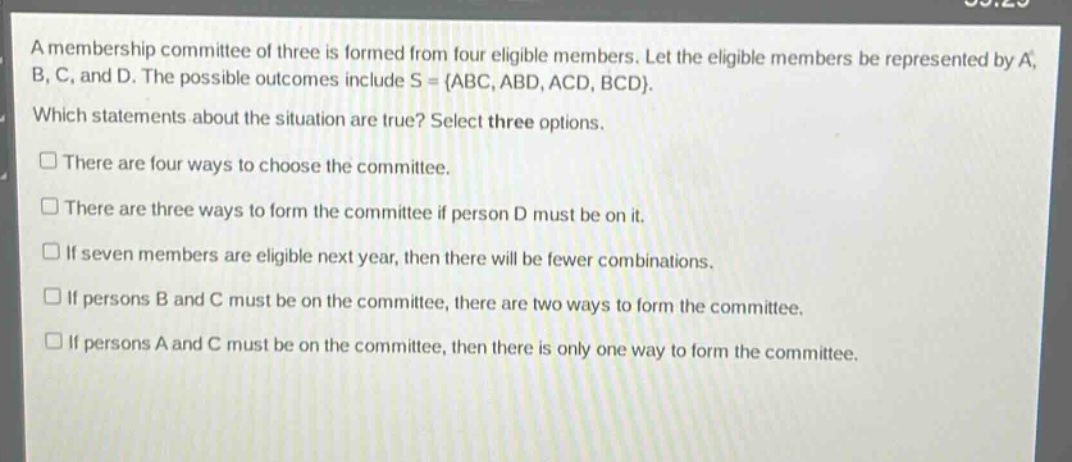
a membership committee of three is formed from four eligible members. let the eligible members be represented by a, b, c, and d. the possible outcomes include s = {abc, abd, acd, bcd}. which statements about the situation are true? select three options. there are four ways to choose the committee. there are three ways to form the committee if person d must be on it. if seven members are eligible next year, then there will be fewer combinations. if persons b and c must be on the committee, there are two ways to form the committee. if persons a and c must be on the committee, then there is only one way to form the committee.
Answer
Explanation:
Step1: Analyze number of ways from 4 members
The set of possible outcomes when choosing 3 - member committee from 4 members is given as $S={ABC, ABD, ACD, BCD}$, so there are 4 ways to choose the committee. This statement is true.
Step2: Analyze case with D in committee
If person D must be on the committee, we need to choose 2 more members from the remaining 3. The combinations are ABD, ACD, BCD. So there are 3 ways to form the committee if person D must be on it. This statement is true.
Step3: Analyze case with B and C in committee
If B and C must be on the committee, we need to choose 1 more member from the remaining 2 (A and D). The combinations are ABC and BCD. So there are 2 ways to form the committee if B and C must be on it. This statement is true.
Step4: Analyze case with A and C in committee
If A and C must be on the committee, we need to choose 1 more member from the remaining 2 (B and D). The combinations are ABC and ACD. So there are 2 ways, not 1 way to form the committee if A and C must be on it. This statement is false.
Step5: Analyze case with 7 members
The number of combinations of choosing 3 - member committee from $n$ members is given by the combination formula $C(n,r)=\frac{n!}{r!(n - r)!}$, where $n$ is the total number of members and $r$ is the number of members to be chosen. For $n = 4,r = 3$, $C(4,3)=\frac{4!}{3!(4 - 3)!}=\frac{4!}{3!1!}=4$. For $n = 7,r = 3$, $C(7,3)=\frac{7!}{3!(7 - 3)!}=\frac{7\times6\times5}{3\times2\times1}=35$. So if seven members are eligible next year, there will be more combinations, not fewer. This statement is false.
Answer:
There are four ways to choose the committee. There are three ways to form the committee if person D must be on it. If persons B and C must be on the committee, there are two ways to form the committee.