the model represents a polynomial of the form ax² + bx + c. which equation is represented by the model? 3x²…
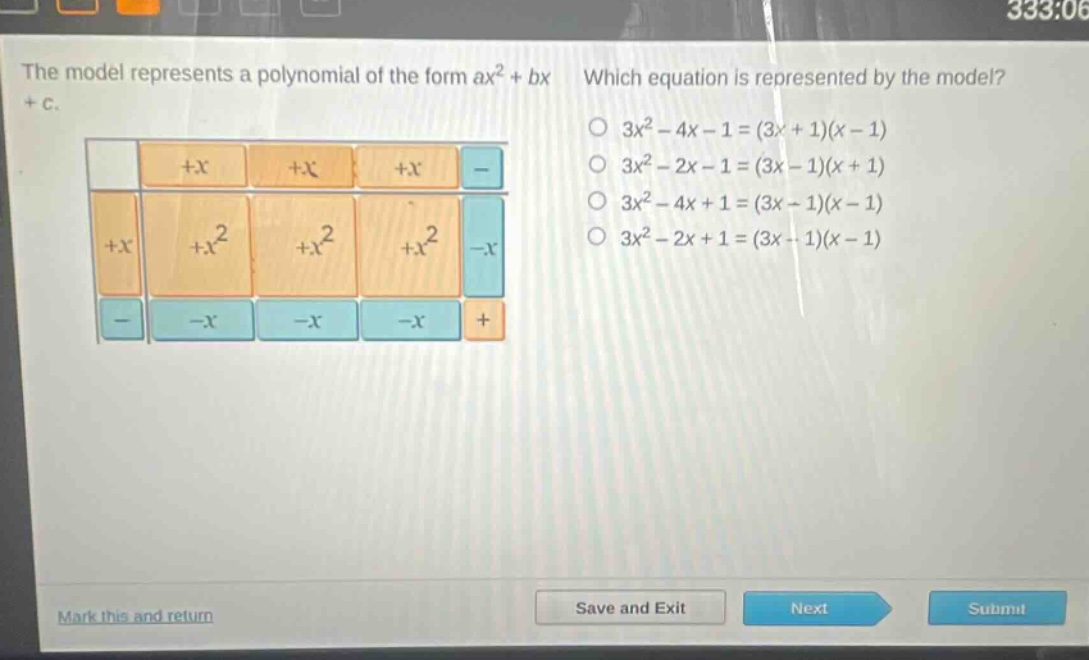
the model represents a polynomial of the form ax² + bx + c. which equation is represented by the model? 3x² - 4x - 1 = (3x + 1)(x - 1) 3x² - 2x - 1 = (3x - 1)(x + 1) 3x² - 4x + 1 = (3x - 1)(x - 1) 3x² - 2x + 1 = (3x - 1)(x - 1)
Answer
Explanation:
Step1: Count the number of $x^{2}$ - terms
There are 3 positive $x^{2}$ - terms, so the coefficient of $x^{2}$ is 3.
Step2: Count the number of $x$ - terms
There are 2 positive $x$ - terms and 6 negative $x$ - terms. $2x-6x=-4x$, so the coefficient of $x$ is - 4.
Step3: Count the constant - terms
There is 1 positive and 1 negative constant - term, $1 - 1 = 0$ (but we can also expand the factored forms to check). Now expand the factored forms:
- Expand $(3x + 1)(x - 1)$:
- Using FOIL method: $(3x\times x)+(3x\times(-1))+(1\times x)+(1\times(-1))=3x^{2}-3x + x-1=3x^{2}-2x - 1$.
- Expand $(3x - 1)(x + 1)$:
- Using FOIL method: $(3x\times x)+(3x\times1)+(-1\times x)+(-1\times1)=3x^{2}+3x - x-1=3x^{2}+2x - 1$.
- Expand $(3x - 1)(x - 1)$:
- Using FOIL method: $(3x\times x)+(3x\times(-1))+(-1\times x)+(-1\times(-1))=3x^{2}-3x - x + 1=3x^{2}-4x + 1$.
- Expand $(3x - 1)(x - 1)$ (again for clarity):
- $3x\times x-3x\times1-1\times x + 1\times1=3x^{2}-3x - x+1=3x^{2}-4x + 1$.
Answer:
C. $3x^{2}-4x + 1=(3x - 1)(x - 1)$