the movement of the progress bar may be uneven because questions can be worth more or less (incl\nwhich area…
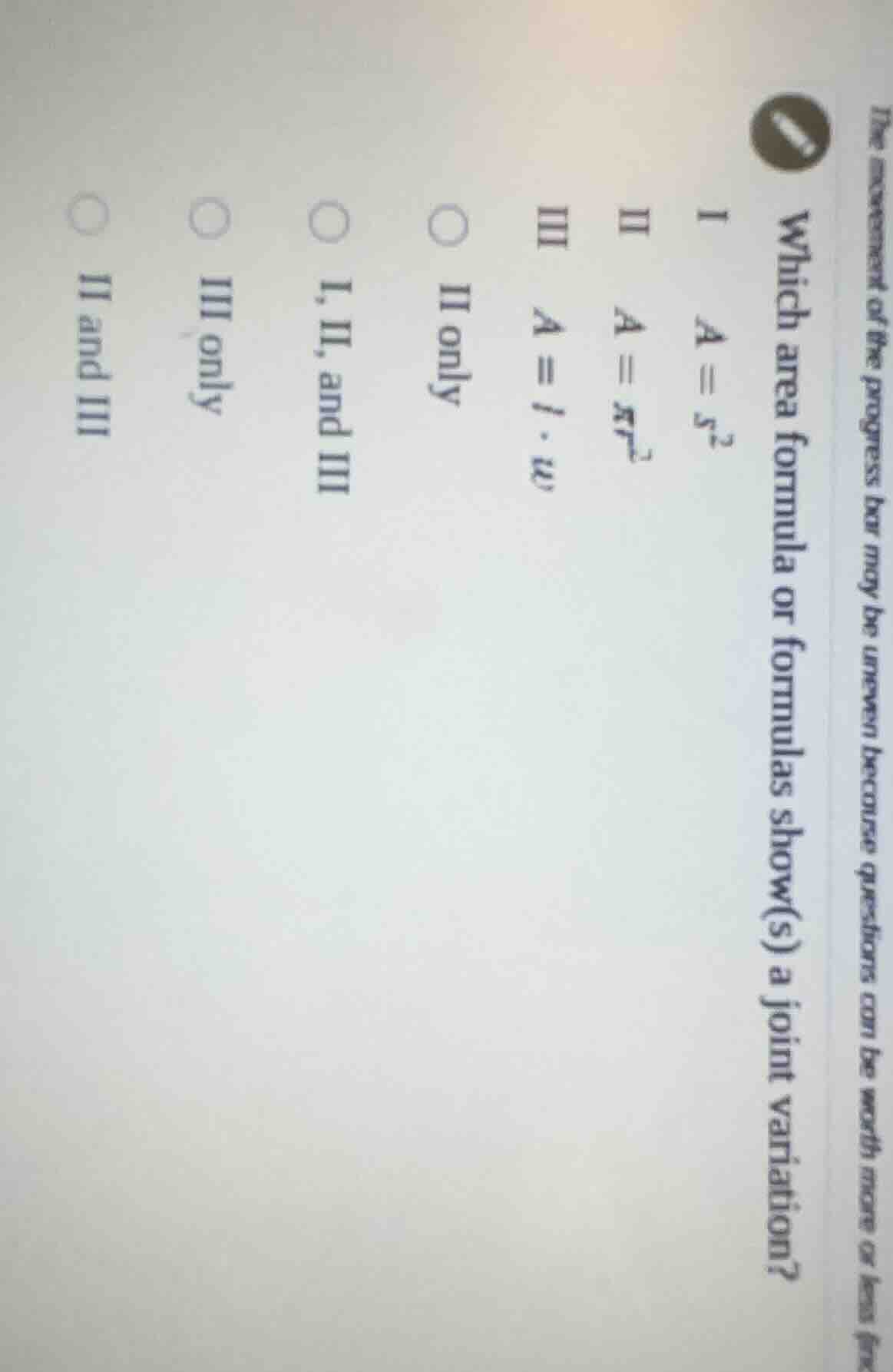
the movement of the progress bar may be uneven because questions can be worth more or less (incl\nwhich area formula or formulas show(s) a joint variation?\ni $a = s^{2}$\nii $a = \\pi r^{2}$\niii $a = l \\cdot w$\n$circ$ ii only\n$circ$ i, ii, and iii\n$circ$ iii only\n$circ$ ii and iii
Answer
Explanation:
Step1: Define joint variation
Joint variation describes a relationship where a variable varies directly as the product of two or more other variables, following the form $A = k \cdot x \cdot y$ where $k$ is a constant.
Step2: Analyze Formula I
$A = s^2$ is $A = 1 \cdot s \cdot s$, which is direct variation with one variable squared, not joint variation of distinct variables.
Step3: Analyze Formula II
$A = \pi r^2$ is $A = \pi \cdot r \cdot r$, same as above, direct variation with one variable squared, not joint variation.
Step4: Analyze Formula III
$A = l \cdot w$ fits $A = 1 \cdot l \cdot w$, where area $A$ varies jointly as length $l$ and width $w$ (constant $k=1$), so this is joint variation.
Answer:
○ III only