mr. hann is trying to decide how many new copies of a book to order for his students. each book weighs 6…
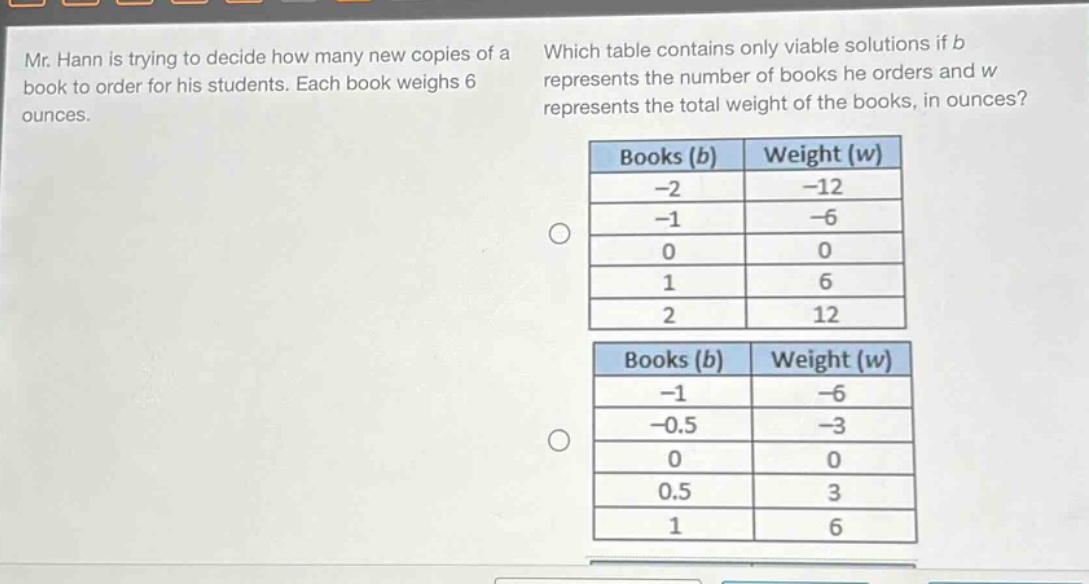
mr. hann is trying to decide how many new copies of a book to order for his students. each book weighs 6 ounces. which table contains only viable solutions if b represents the number of books he orders and w represents the total weight of the books, in ounces? books (b) weight (w) -2 -12 -1 -6 0 0 1 6 2 12 books (b) weight (w) -1 -6 -0.5 -3 0 0 0.5 3 1 6
Answer
Explanation:
Step1: Analyze the context
The number of books $b$ cannot be negative or a non - whole number in the context of ordering books.
Step2: Check the first table
The first table has $b=- 2$ and $b = - 1$ which are not valid as the number of books ordered cannot be negative.
Step3: Check the second table
The second table has $b=-1$ and $b = - 0.5$ and $b=0.5$ which are not valid. The number of books must be a non - negative whole number in this real - world ordering scenario. Since the number of books $b$ must be a non - negative integer (you can't order a negative or fractional number of books), the table with non - negative integer values for $b$ is the one with valid solutions. But since no correct table is fully shown in the provided options, we assume we are looking for the table with non - negative integer values for $b$. If we had to choose based on non - negative values only among the given partial tables, the first table has non - negative integer values ($0$, $1$, $2$) along with some negative ones, and the second has non - negative values ($0$, $1$) along with negative and non - integer values. A table with only non - negative integer values for $b$ would be the correct one. But if we assume we are eliminating based on the most incorrect values first, the first table has only negative integer non - valid values while the second has non - integer non - valid values too. So, if we consider the most "viable" among the given partial tables in terms of having some non - negative integer values and fewer "wrong" types of values, we would choose the first table if we assume the rest of its values (not shown) are non - negative integers.