mr. jones asks his students to generate the next two numbers in the sequence beginning -5.5, 11, .... taquan…
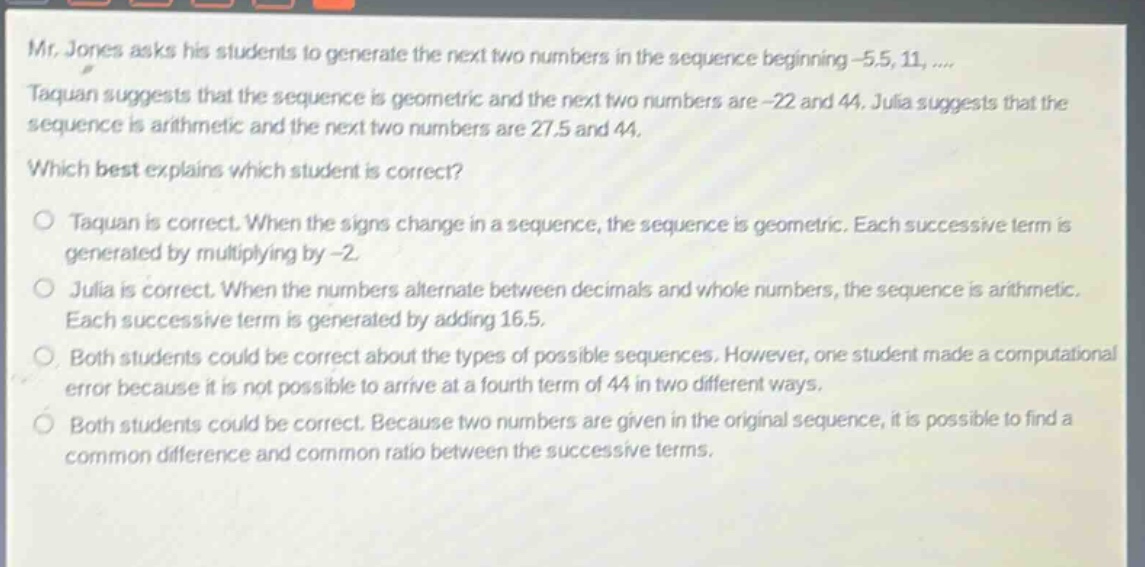
mr. jones asks his students to generate the next two numbers in the sequence beginning -5.5, 11, .... taquan suggests that the sequence is geometric and the next two numbers are -22 and 44. julia suggests that the sequence is arithmetic and the next two numbers are 27.5 and 44. which best explains which student is correct? o taquan is correct. when the signs change in a sequence, the sequence is geometric. each successive term is generated by multiplying by -2. o julia is correct. when the numbers alternate between decimals and whole numbers, the sequence is arithmetic. each successive term is generated by adding 16.5. o both students could be correct about the types of possible sequences. however, one student made a computational error because it is not possible to arrive at a fourth term of 44 in two different ways. o both students could be correct. because two numbers are given in the original sequence, it is possible to find a common difference and common ratio between the successive terms.
Answer
Explanation:
Step1: Check Taquan's geometric - sequence claim
For a geometric sequence, the common ratio $r$ is found by $\frac{a_{n + 1}}{a_{n}}$. If the first term $a_1=-5.5$ and the second term $a_2 = 11$, then $r=\frac{11}{-5.5}=-2$. The third - term $a_3=a_2\times r=11\times(-2)=-22$, and the fourth - term $a_4=a_3\times r=-22\times(-2)=44$.
Step2: Check Julia's arithmetic - sequence claim
For an arithmetic sequence, the common difference $d$ is found by $a_{n + 1}-a_{n}$. If $a_1=-5.5$ and $a_2 = 11$, then $d=11-(-5.5)=11 + 5.5=16.5$. The third - term $a_3=a_2 + d=11+16.5 = 27.5$, and the fourth - term $a_4=a_3 + d=27.5+16.5 = 44$.
Answer:
Both students could be correct. Because two numbers are given in the original sequence, it is possible to find a common difference and common ratio between the successive terms.