mrs. jackson gives the table below to her students. in order for the function to be linear, what must a be…
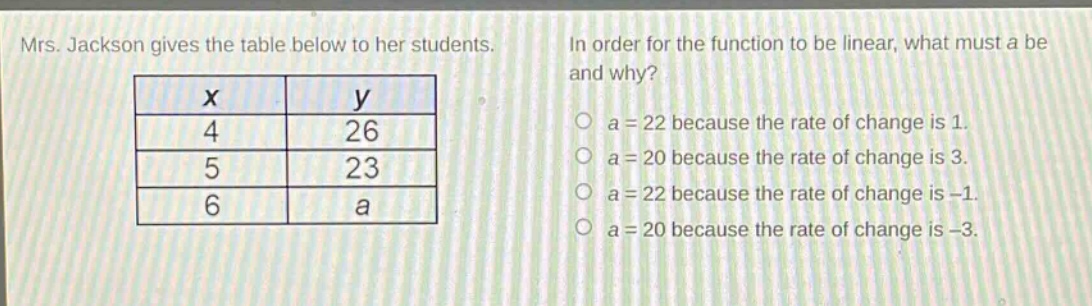
mrs. jackson gives the table below to her students. in order for the function to be linear, what must a be and why?\n| x | y |\n|----|----| \n| 4 | 26 |\n| 5 | 23 |\n| 6 | a |\n a = 22 because the rate of change is 1.\n a = 20 because the rate of change is 3.\n a = 22 because the rate of change is -1.\n a = 20 because the rate of change is -3.
Answer
Explanation:
Step1: Calculate the rate of change
The rate of change (slope) $m$ between two points $(x_1,y_1)$ and $(x_2,y_2)$ is given by $m=\frac{y_2 - y_1}{x_2 - x_1}$. Using the points $(4,26)$ and $(5,23)$, we have $x_1 = 4,y_1=26,x_2 = 5,y_2 = 23$. Then $m=\frac{23 - 26}{5 - 4}=\frac{- 3}{1}=-3$.
Step2: Use the rate of change to find $a$
We know the rate of change between $(5,23)$ and $(6,a)$ should also be $-3$. Using the slope formula $m=\frac{a - 23}{6 - 5}=-3$. Since $6 - 5=1$, then $a-23=-3\times1$. Solving for $a$, we get $a=23-3 = 20$.
Answer:
a = 20 because the rate of change is -3.