ms. wilson draws a model of the factorization of a polynomial with integer factors. her model is partially…
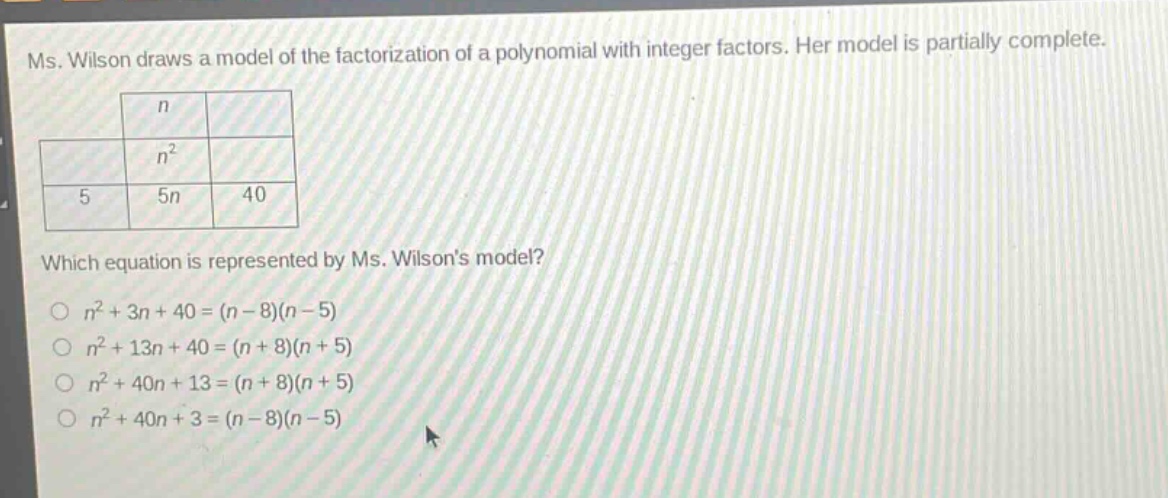
ms. wilson draws a model of the factorization of a polynomial with integer factors. her model is partially complete. which equation is represented by ms. wilsons model? o $n^{2}+3n + 40=(n - 8)(n - 5)$ o $n^{2}+13n + 40=(n + 8)(n + 5)$ o $n^{2}+40n + 13=(n + 8)(n + 5)$ o $n^{2}+40n + 3=(n - 8)(n - 5)$
Answer
Explanation:
Step1: Expand the factored - form of a quadratic
The general form of factoring a quadratic ((x + a)(x + b)=x^{2}+(a + b)x+ab).
Step2: Analyze the constant term in the model
In the model, the product of the non - variable terms is (5\times8 = 40). So the constant term of the quadratic polynomial should be 40.
Step3: Analyze the coefficient of the linear term
The coefficient of the linear term in the quadratic polynomial comes from the sum of the cross - products. If the factors are ((n + 8)(n + 5)), then the coefficient of the linear term is (8 + 5=13). And the quadratic polynomial is (n^{2}+13n + 40).
Step4: Expand ((n + 8)(n + 5))
Using the FOIL method: ((n + 8)(n + 5)=n\times n+n\times5+8\times n + 8\times5=n^{2}+5n+8n + 40=n^{2}+13n + 40).
Answer:
B. (n^{2}+13n + 40=(n + 8)(n + 5))