ms. wilson draws a model of the factorization of a polynomial with integer factors. her model is partially…
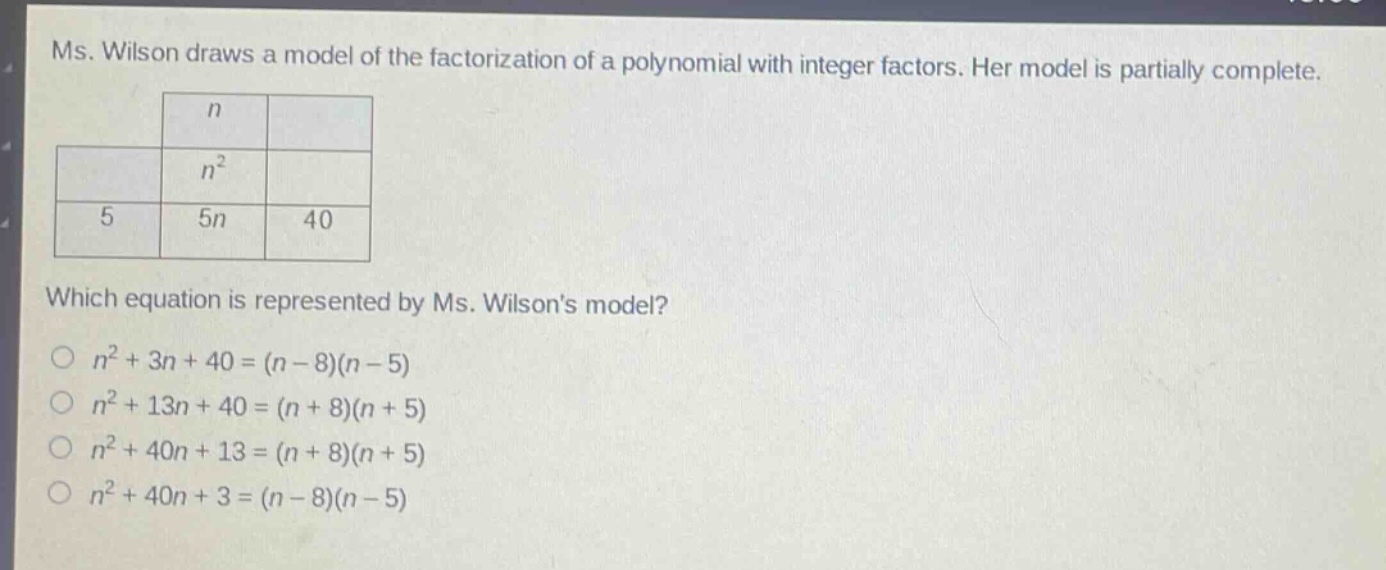
ms. wilson draws a model of the factorization of a polynomial with integer factors. her model is partially complete.\nwhich equation is represented by ms. wilsons model?\n$n^{2}+3n + 40=(n - 8)(n - 5)$\n$n^{2}+13n + 40=(n + 8)(n + 5)$\n$n^{2}+40n + 13=(n + 8)(n + 5)$\n$n^{2}+40n + 3=(n - 8)(n - 5)$
Answer
Explanation:
Step1: Expand the factored - form polynomials
For a polynomial in the factored form ((a + b)(c + d)=ac+ad+bc+bd). For ((n + 8)(n + 5)), we have (n\times n+n\times5+8\times n + 8\times5). [ \begin{align*} (n + 8)(n + 5)&=n^{2}+5n+8n + 40\ &=n^{2}+(5 + 8)n+40\ &=n^{2}+13n + 40 \end{align*} ]
Step2: Check other options
For ((n - 8)(n - 5)=n^{2}-5n-8n + 40=n^{2}-13n + 40\neq n^{2}+3n + 40). For ((n + 8)(n + 5)=n^{2}+13n + 40\neq n^{2}+40n + 13). For ((n - 8)(n - 5)=n^{2}-13n + 40\neq n^{2}+40n + 3).
Answer:
B. (n^{2}+13n + 40=(n + 8)(n + 5))