1. multiply.\n3 2/4×2 2/5 = \n2. write the rule for the table.\ninput output\n4 1\n8 2\n12 3\n16…
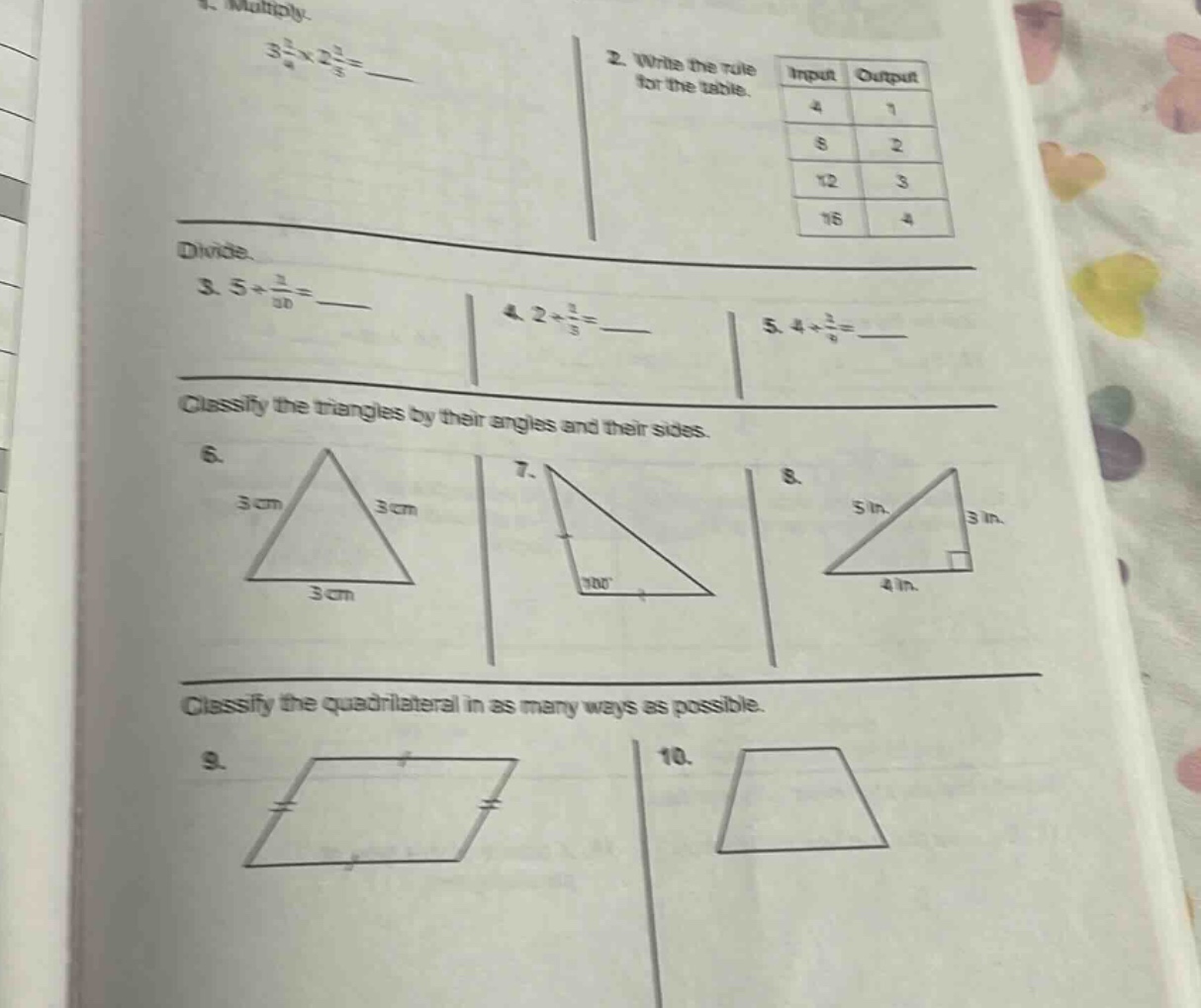
1. multiply.\n3 2/4×2 2/5 = \n2. write the rule for the table.\ninput output\n4 1\n8 2\n12 3\n16 4\ndivide.\n3. 5÷1/10 = \n4. 2÷1/3 = \n5. 4÷2/6 = \nclassify the triangles by their angles and their sides.\n6.\n3 cm 3 cm\n3 cm\n7.\n100°\n8.\n5 in. 3 in.\n4 in.\nclassify the quadrilateral in as many ways as possible.\n9.\n10.
Answer
Answer:
- First, convert mixed - numbers to improper fractions:
- (3\frac{2}{4}=\frac{3\times4 + 2}{4}=\frac{14}{4}), (2\frac{2}{5}=\frac{2\times5+2}{5}=\frac{12}{5})
- Then multiply: (\frac{14}{4}\times\frac{12}{5}=\frac{14\times12}{4\times5}=\frac{168}{20}=\frac{42}{5} = 8\frac{2}{5})
- The rule for the table: Output=(\frac{Input}{4})
- (5\div\frac{1}{10}=5\times10 = 50)
- (2\div\frac{1}{3}=2\times3=6)
- (4\div\frac{2}{9}=4\times\frac{9}{2}=18)
- By sides: Equilateral triangle (all sides are 3 cm). By angles: Acute - angled triangle (since all angles of an equilateral triangle are (60^{\circ}))
- By sides: Scalene triangle (no equal sides). By angles: Obtuse - angled triangle (one angle is (100^{\circ}))
- By sides: Scalene triangle (sides are 3 in, 4 in, 5 in). By angles: Right - angled triangle (has a (90^{\circ}) angle)
- Parallelogram (opposite sides are parallel and equal), Quadrilateral (4 - sided polygon)
- Trapezoid (has one pair of parallel sides), Quadrilateral (4 - sided polygon)
Explanation:
Step1: Convert mixed - numbers
For (3\frac{2}{4}) and (2\frac{2}{5}), use (a\frac{b}{c}=\frac{ac + b}{c})
Step2: Multiply fractions
Use (\frac{a}{b}\times\frac{c}{d}=\frac{ac}{bd})
Step3: Find table rule
Notice (1=\frac{4}{4}), (2=\frac{8}{4}), (3=\frac{12}{4}), (4=\frac{16}{4})
Step4: Divide by a fraction
Use (a\div\frac{b}{c}=a\times\frac{c}{b})
Step5: Classify triangles by sides
Check for equal side lengths
Step6: Classify triangles by angles
Check for right ((90^{\circ})), acute ((<90^{\circ})), or obtuse ((>90^{\circ})) angles
Step7: Classify quadrilaterals
Check for parallel sides and general 4 - sided nature