multiplying $\frac{3}{sqrt{17}-sqrt{2}}$ by which fraction will produce an equivalent fraction with a…
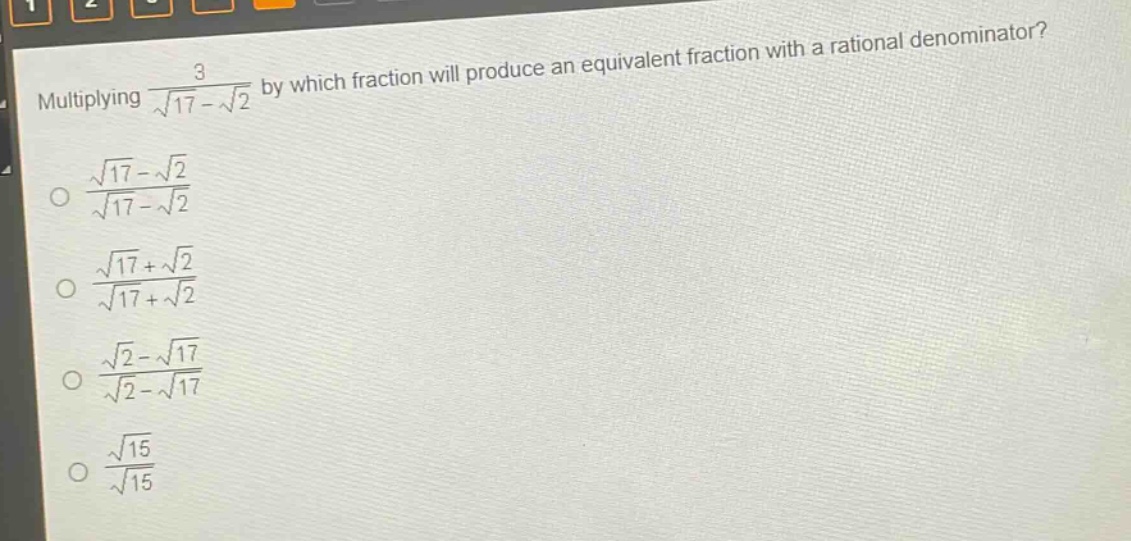
multiplying $\frac{3}{sqrt{17}-sqrt{2}}$ by which fraction will produce an equivalent fraction with a rational denominator?\n$\frac{sqrt{17}-sqrt{2}}{sqrt{17}-sqrt{2}}$\n$\frac{sqrt{17}+sqrt{2}}{sqrt{17}+sqrt{2}}$\n$\frac{sqrt{2}-sqrt{17}}{sqrt{2}-sqrt{17}}$\n$\frac{sqrt{15}}{sqrt{15}}$
Answer
Explanation:
Step1: Recall rationalizing the denominator
To rationalize the denominator of a fraction with the form $\frac{a}{b - c}$ where $b$ and $c$ are square - root terms, we multiply by the conjugate of the denominator. The conjugate of $\sqrt{17}-\sqrt{2}$ is $\sqrt{17}+\sqrt{2}$. When we multiply $\frac{3}{\sqrt{17}-\sqrt{2}}$ by $\frac{\sqrt{17}+\sqrt{2}}{\sqrt{17}+\sqrt{2}}$, we use the difference - of - squares formula $(a - b)(a + b)=a^{2}-b^{2}$ in the denominator. Here, $a=\sqrt{17}$ and $b = \sqrt{2}$, so $(\sqrt{17}-\sqrt{2})(\sqrt{17}+\sqrt{2})=(\sqrt{17})^{2}-(\sqrt{2})^{2}=17 - 2=15$, which is a rational number.
Answer:
B. $\frac{\sqrt{17}+\sqrt{2}}{\sqrt{17}+\sqrt{2}}$