myra uses an inverse variation function to model the data for the ordered pairs below. (2, 30), (3, 20), (4…
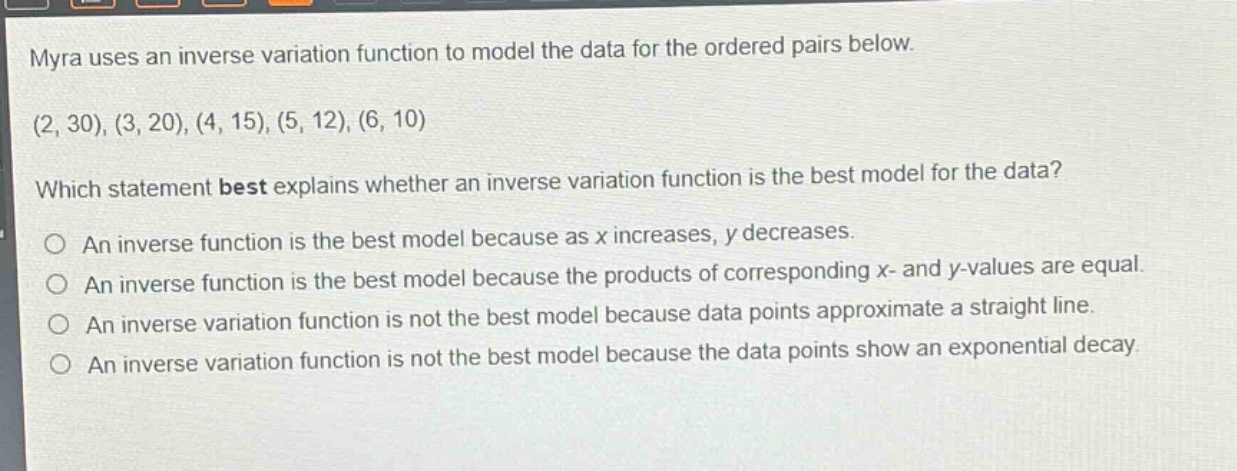
myra uses an inverse variation function to model the data for the ordered pairs below. (2, 30), (3, 20), (4, 15), (5, 12), (6, 10) which statement best explains whether an inverse variation function is the best model for the data? an inverse function is the best model because as x increases, y decreases. an inverse function is the best model because the products of corresponding x - and y - values are equal. an inverse variation function is not the best model because data points approximate a straight line. an inverse variation function is not the best model because the data points show an exponential decay.
Answer
Answer:
An inverse function is the best model because the products of corresponding x - and y - values are equal.
Explanation:
Step1: Recall inverse - variation formula
For inverse variation, $xy = k$ (constant).
Step2: Calculate products for each pair
For $(2,30)$: $2\times30 = 60$. For $(3,20)$: $3\times20 = 60$. For $(4,15)$: $4\times15 = 60$. For $(5,12)$: $5\times12 = 60$. For $(6,10)$: $6\times10 = 60$. Since the product $xy$ is constant ($k = 60$) for all ordered - pairs, an inverse variation function is the best model.