name: date: period: assignment - financial literacy, day 3 simple & compound interest grade 8 lowman…
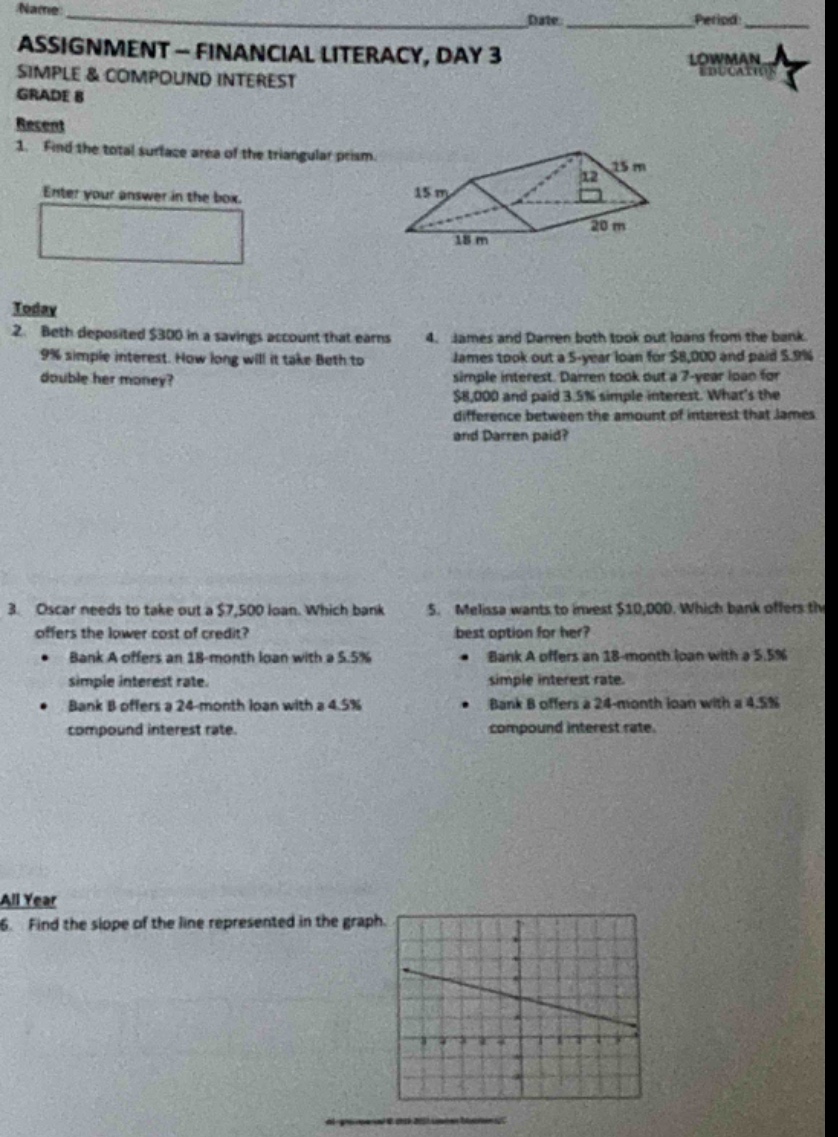
name: date: period: assignment - financial literacy, day 3 simple & compound interest grade 8 lowman education recent 1. find the total surface area of the triangular prism. enter your answer in the box. 15 m 15 m 12 20 m 18 m today 2. beth deposited $300 in a savings account that earns 9% simple interest. how long will it take beth to double her money? 4. james and darren both took out loans from the bank. james took out a 5 - year loan for $8,000 and paid 5.9% simple interest. darren took out a 7 - year loan for $8,000 and paid 3.5% simple interest. whats the difference between the amount of interest that james and darren paid? 3. oscar needs to take out a $7,500 loan. which bank offers the lower cost of credit? - bank a offers an 18 - month loan with a 5.5% simple interest rate. - bank b offers a 24 - month loan with a 4.5% compound interest rate. 5. melissa wants to invest $10,000. which bank offers the best option for her? - bank a offers an 18 - month loan with a 5.5% simple interest rate. - bank b offers a 24 - month loan with a 4.5% compound interest rate. all year 6. find the slope of the line represented in the graph.
Answer
1. Find the total surface area of the triangular prism
Explanation:
Step1: Find area of triangular bases
The area formula for a triangle is $A=\frac{1}{2}bh$. Here, $b = 20$ m and $h=12$ m. So, $A_{base}=\frac{1}{2}\times20\times12= 120$ m². Since there are 2 triangular bases, the total area of the bases is $2\times120 = 240$ m².
Step2: Find area of rectangular - faces
There are 3 rectangular faces. Face 1: With dimensions 15 m and 18 m, $A_1=15\times18 = 270$ m². Face 2: With dimensions 15 m and 20 m, $A_2=15\times20 = 300$ m². Face 3: With dimensions 15 m and $\sqrt{12^{2}+20^{2}}=\sqrt{144 + 400}=\sqrt{544}=4\sqrt{34}\approx23.32$ m (using Pythagorean theorem for the non - rectangular side of the triangular base, but we can also use the fact that the slant height of the prism related to the triangular base). However, we can also calculate the areas of the rectangles directly from the given side - lengths. The third rectangle has dimensions 15 m and 18 m (by visual inspection of the prism). So $A_3 = 15\times18=270$ m². The sum of the areas of the rectangular faces is $270 + 300+270=840$ m².
Step3: Calculate total surface area
The total surface area $A_{total}$ of the triangular prism is the sum of the area of the bases and the area of the rectangular faces. So, $A_{total}=240 + 840=1080$ m².
Answer:
1080
2. Beth deposited $300 in a savings account that earns 9% simple interest. How long will it take Beth to double her money?
Explanation:
Step1: Recall the simple - interest formula
The simple - interest formula is $I = Prt$, where $I$ is the interest, $P$ is the principal amount, $r$ is the interest rate (in decimal form), and $t$ is the time in years. We want to double the money, so $I = P$. Given $P=$300$ and $r = 0.09$.
Step2: Substitute values into the formula
Since $I = P$, we have $P=Prt$. Canceling out $P$ (since $P\neq0$), we get $1=rt$. Substituting $r = 0.09$ into the equation $1 = rt$, we can solve for $t$. So, $t=\frac{1}{r}=\frac{1}{0.09}\approx11.11$ years.
Answer:
$\frac{100}{9}\approx11.11$ years
4. James and Darren both took out loans from the bank. James took out a 5 - year loan for $8000 and paid 5.9% simple interest. Darren took out a 7 - year loan for $8000 and paid 3.5% simple interest. What's the difference between the amount of interest that James and Darren paid?
Explanation:
Step1: Calculate James' interest
Using the simple - interest formula $I = Prt$, for James, $P = 8000$, $r=0.059$, and $t = 5$. So, $I_J=8000\times0.059\times5=8000\times0.295 = 2360$.
Step2: Calculate Darren's interest
Using the simple - interest formula $I = Prt$, for Darren, $P = 8000$, $r = 0.035$, and $t = 7$. So, $I_D=8000\times0.035\times7=8000\times0.245=1960$.
Step3: Find the difference
The difference $\Delta I=I_J - I_D=2360 - 1960 = 400$.
Answer:
400
3. Oscar needs to take out a $7500 loan. Which bank offers the lower cost of credit?
Explanation:
Step1: Calculate the cost of credit for Bank A
Bank A offers an 18 - month ($t_A=\frac{18}{12}=1.5$ years) loan with a 5.5% ($r_A = 0.055$) simple - interest rate. Using the simple - interest formula $I = Prt$, we have $I_A=7500\times0.055\times1.5=7500\times0.0825 = 618.75$.
Step2: Calculate the cost of credit for Bank B
Bank B offers a 24 - month ($t_B = 2$ years) loan with a 4.5% ($r_B=0.045$) compound - interest rate. The compound - interest formula is $A=P(1 + r)^t$, where $A$ is the amount after $t$ years, $P$ is the principal, $r$ is the annual interest rate, and $t$ is the number of years. First, find $A_B=7500(1 + 0.045)^2=7500\times(1.045)^2=7500\times1.092025 = 8190.1875$. The interest $I_B=A_B - P=8190.1875-7500 = 690.1875$.
Step3: Compare the two interests
Since $618.75<690.1875$, Bank A offers the lower cost of credit.
Answer:
Bank A
5. Melissa wants to invest $10000. Which bank offers the best option for her?
Explanation:
Step1: Calculate the return for Bank A
Bank A offers an 18 - month ($t_A=\frac{18}{12}=1.5$ years) loan with a 5.5% ($r_A = 0.055$) simple - interest rate. Using the simple - interest formula $I = Prt$, the interest $I_A=10000\times0.055\times1.5=825$. The total amount $A_A=P + I_A=10000 + 825=10825$.
Step2: Calculate the return for Bank B
Bank B offers a 24 - month ($t_B = 2$ years) loan with a 4.5% ($r_B = 0.045$) compound - interest rate. Using the compound - interest formula $A=P(1 + r)^t$, we have $A_B=10000(1 + 0.045)^2=10000\times1.092025 = 10920.25$.
Step3: Compare the two amounts
Since $10920.25>10825$, Bank B offers the best option for Melissa.
Answer:
Bank B
6. Find the slope of the line represented in the graph
(No graph details provided here. But the general formula for slope $m=\frac{y_2 - y_1}{x_2 - x_1}$ if two points $(x_1,y_1)$ and $(x_2,y_2)$ on the line are known). If we assume two points $(x_1,y_1)$ and $(x_2,y_2)$ on the line from the graph, we calculate the slope as follows:
Explanation:
Let the two points be $(x_1,y_1)$ and $(x_2,y_2)$.
Step1: Identify the coordinates of two points
(Assume we identify two points on the line from the graph).
Step2: Apply the slope formula
$m=\frac{y_2 - y_1}{x_2 - x_1}$ (Without the actual graph, we can't give a numerical answer. But the process is as above).
Answer:
(Depends on the points on the graph. If points are $(x_1,y_1)$ and $(x_2,y_2)$, slope is $\frac{y_2 - y_1}{x_2 - x_1}$)