nina knows that the average of the x - intercepts represents the line of symmetry for a quadratic function…
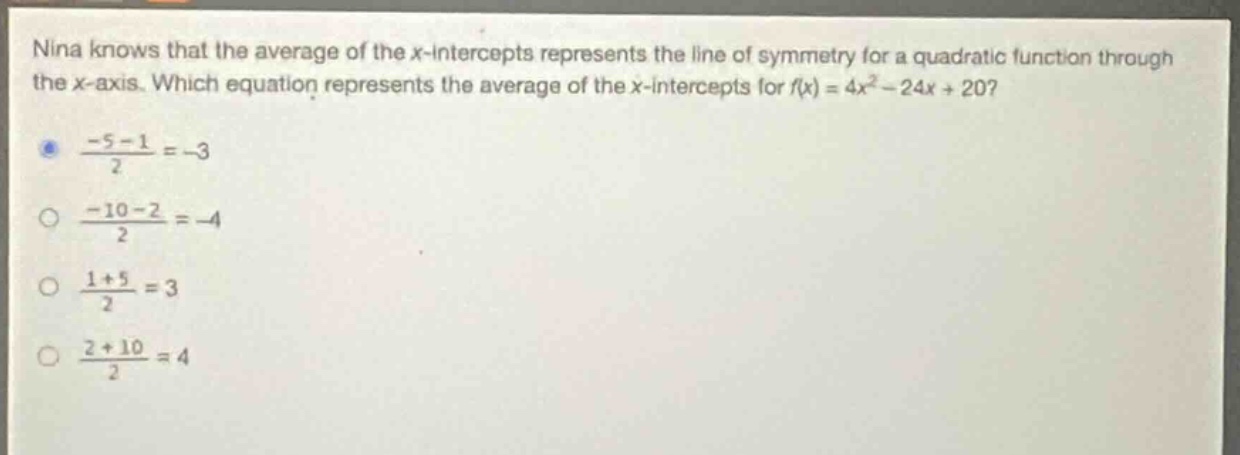
nina knows that the average of the x - intercepts represents the line of symmetry for a quadratic function through the x - axis. which equation represents the average of the x - intercepts for (f(x)=4x^{2}-24x + 20)?\n(\frac{-5 - 1}{2}=-3)\n(\frac{-10 - 2}{2}=-4)\n(\frac{1 + 5}{2}=3)\n(\frac{2+10}{2}=4)
Answer
Explanation:
Step1: Set the function equal to 0.
Set $f(x)=4x^{2}-24x + 20=0$. Divide through by 4 to simplify: $x^{2}-6x + 5=0$.
Step2: Factor the quadratic equation.
Factor $x^{2}-6x + 5$ as $(x - 1)(x - 5)=0$.
Step3: Find the x - intercepts.
Set each factor equal to 0: $x-1=0$ gives $x = 1$ and $x - 5=0$ gives $x = 5$.
Step4: Calculate the average of the x - intercepts.
The average of two numbers $a$ and $b$ is $\frac{a + b}{2}$. Here $a = 1$ and $b = 5$, so the average is $\frac{1+5}{2}=3$.
Answer:
C. $\frac{1 + 5}{2}=3$