nosaira solved an equation. her work is shown below: 1. 3(2x + 1)=2(x + 1)+1 2. 6x + 3 = 2x+2 + 1 3. 6x + 3…
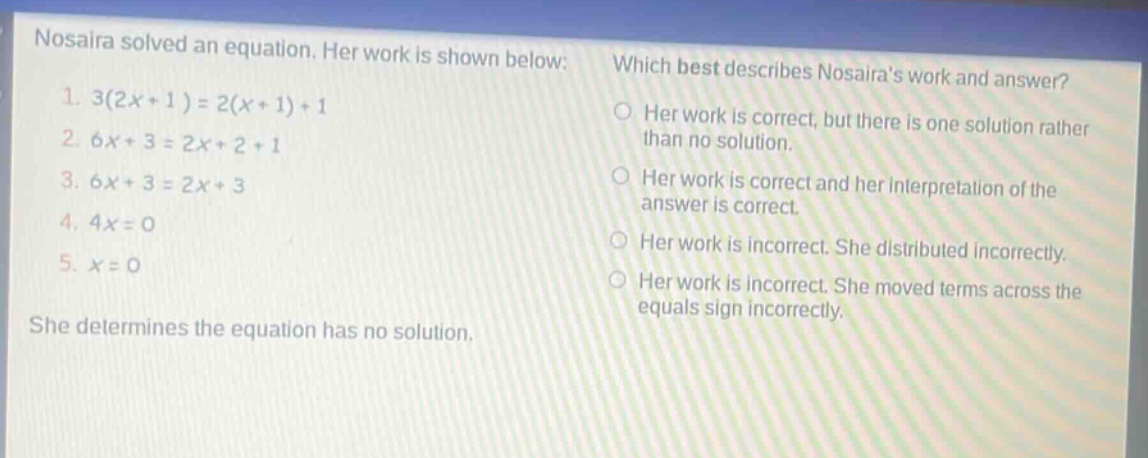
nosaira solved an equation. her work is shown below: 1. 3(2x + 1)=2(x + 1)+1 2. 6x + 3 = 2x+2 + 1 3. 6x + 3 = 2x + 3 4. 4x = 0 5. x = 0 she determines the equation has no solution. which best describes nosairas work and answer? her work is correct, but there is one solution rather than no solution. her work is correct and her interpretation of the answer is correct. her work is incorrect. she distributed incorrectly. her work is incorrect. she moved terms across the equals sign incorrectly.
Answer
Explanation:
Step1: Analyze distribution
Starting with $3(2x + 1)=2(x + 1)+1$. Using the distributive property $a(b + c)=ab+ac$, we get $6x+3 = 2x+2 + 1$, which is correct.
Step2: Simplify right - hand side
Combining like terms on the right - hand side of $6x+3 = 2x+2 + 1$, we have $6x+3=2x + 3$, which is correct.
Step3: Isolate variable terms
Subtracting $2x$ from both sides and subtracting 3 from both sides of $6x+3=2x + 3$ gives $4x=0$, then $x = 0$. So the equation has a solution ($x = 0$).
Answer:
Her work is correct, but there is one solution rather than no solution.