now lets try raising a power to a power. write (10²) \nexpression\tfactors of the base\tsingle\n(10²)³\t10²·1…
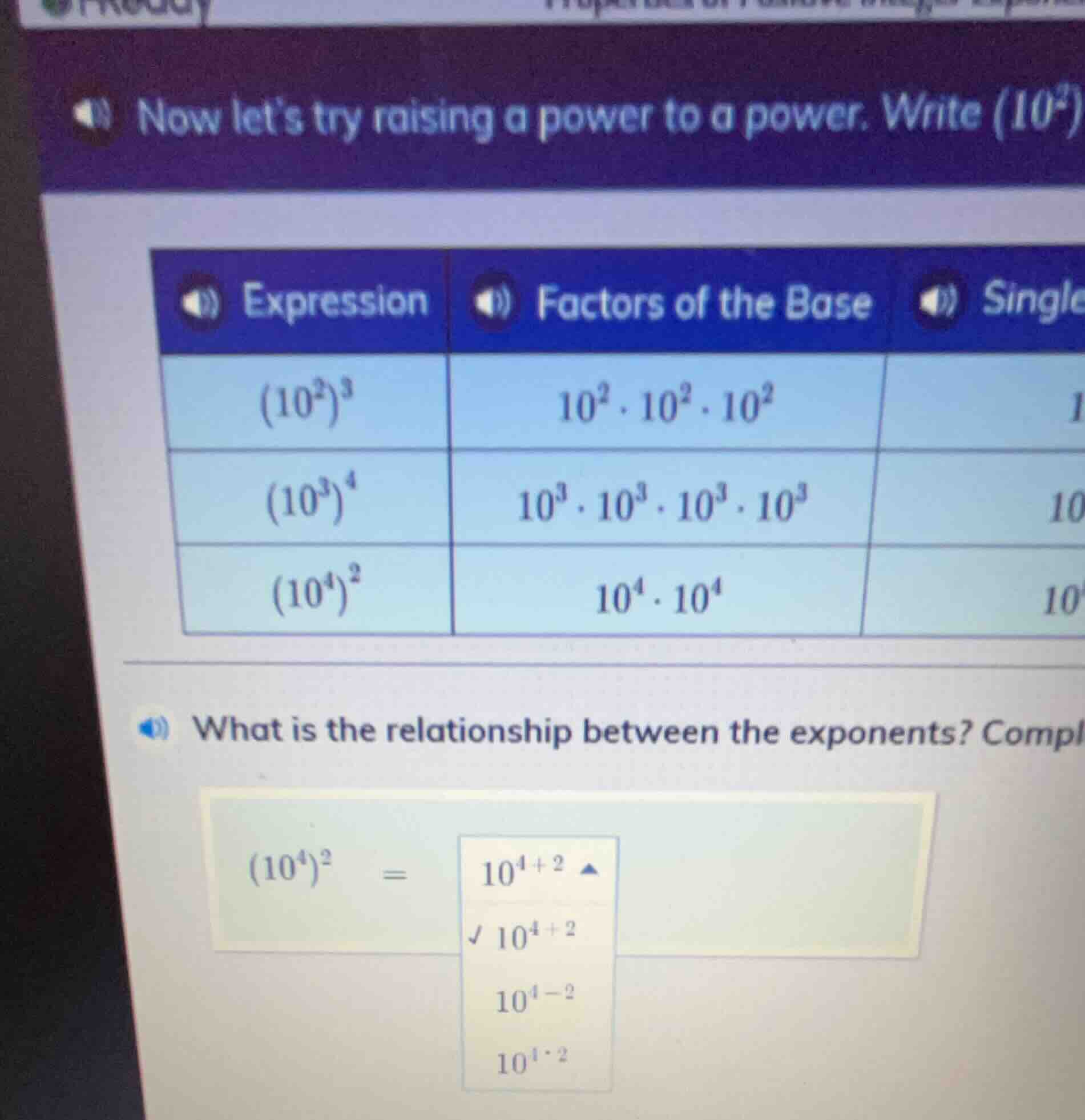
now lets try raising a power to a power. write (10²) \nexpression\tfactors of the base\tsingle\n(10²)³\t10²·10²·10²\t1\n(10³)⁴\t10³·10³·10³·10³\t10\n(10⁴)²\t10⁴·10⁴\t10\nwhat is the relationship between the exponents? compl\n(10⁴)² = \n10⁴⁺² \n√ 10⁴⁺² \n10⁴⁻² \n10⁴·²
Answer
Explanation:
Step1: Recall power of a power rule
For $(a^m)^n$, multiply exponents: $(a^m)^n = a^{m \cdot n}$
Step2: Apply rule to $(10^4)^2$
Substitute $a=10$, $m=4$, $n=2$: $(10^4)^2 = 10^{4 \cdot 2}$
Step3: Verify with factor expansion
$10^4 \cdot 10^4 = 10^{4+4} = 10^{8}$, and $4 \cdot 2 = 8$, so the correct form uses multiplication.
Answer:
$10^{4 \cdot 2}$ (the option $10^{4 \cdot 2}$)