when a number is added to $\frac{1}{5}$ of itself, the result is 24. the equation that models this problem…
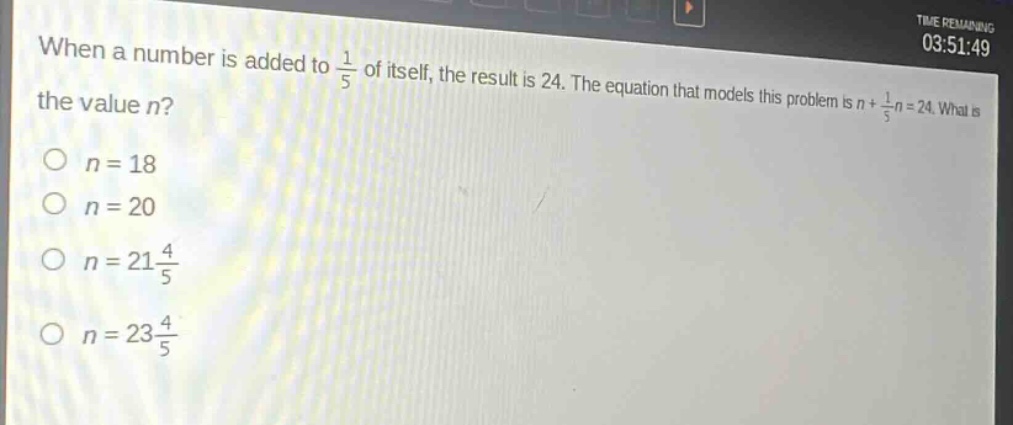
when a number is added to $\frac{1}{5}$ of itself, the result is 24. the equation that models this problem is $n+\frac{1}{5}n = 24$. what is the value $n$?\n$n = 18$\n$n = 20$\n$n = 21\frac{4}{5}$\n$n = 23\frac{4}{5}$
Answer
Answer:
B. $n = 20$
Explanation:
Step1: Combinar términos en el lado izquierdo
$n+\frac{1}{5}n=\left(1 + \frac{1}{5}\right)n=\frac{5 + 1}{5}n=\frac{6}{5}n$
Step2: Resolver la ecuación
$\frac{6}{5}n=24$ Multiplicamos ambos lados por $\frac{5}{6}$: $n = 24\times\frac{5}{6}$ $n=\frac{24\times5}{6}=\frac{120}{6}=20$