one of the roots of a particular polynomial is 3 + i. choose all the possible root combinations for the…
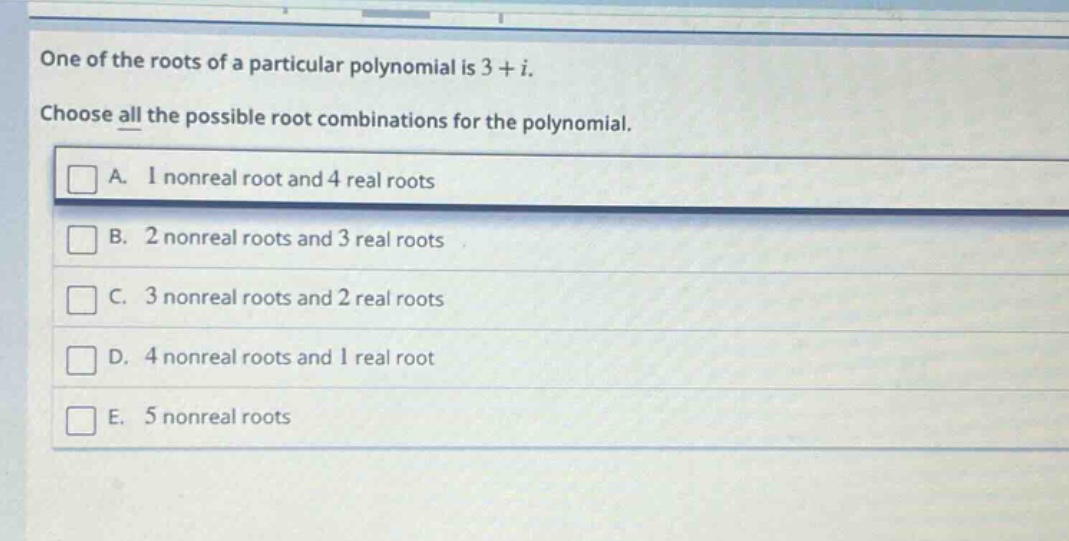
one of the roots of a particular polynomial is 3 + i. choose all the possible root combinations for the polynomial. a. 1 nonreal root and 4 real roots b. 2 nonreal roots and 3 real roots c. 3 nonreal roots and 2 real roots d. 4 nonreal roots and 1 real root e. 5 nonreal roots
Answer
Explanation:
Step1: Recall complex - conjugate root theorem
If a polynomial has real coefficients, complex roots occur in conjugate pairs. Given a root (3 + i), its conjugate (3 - i) is also a root.
Step2: Analyze each option
- Option A: A polynomial with real coefficients cannot have 1 non - real root since non - real roots come in pairs. So this option is incorrect.
- Option B: If there are 2 non - real roots (the given (3 + i) and its conjugate (3 - i)) and 3 real roots, this is possible for a polynomial with real coefficients.
- Option C: Since non - real roots come in pairs, having 3 non - real roots is not possible for a polynomial with real coefficients. So this option is incorrect.
- Option D: If there are 4 non - real roots (two pairs of complex conjugates) and 1 real root, this is possible for a polynomial with real coefficients.
- Option E: Having 5 non - real roots is not possible for a polynomial with real coefficients as non - real roots come in pairs.
Answer:
B. 2 nonreal roots and 3 real roots, D. 4 nonreal roots and 1 real root