which is one of the transformations applied to the graph of $f(x)=x^{2}$ to produce the graph of…
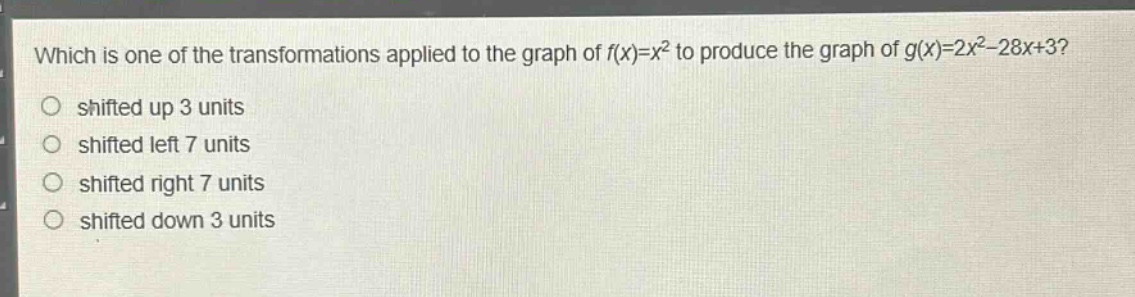
which is one of the transformations applied to the graph of $f(x)=x^{2}$ to produce the graph of $g(x)=2x^{2}-28x + 3$?\nshifted up 3 units\nshifted left 7 units\nshifted right 7 units\nshifted down 3 units
Answer
Explanation:
Step1: Complete the square for $g(x)$.
We start with $g(x)=2x^{2}-28x + 3$. Factor out the coefficient of $x^{2}$ from the first - two terms: $g(x)=2(x^{2}-14x)+3$. To complete the square inside the parentheses, we take half of the coefficient of $x$ (where the coefficient of $x$ is $- 14$), square it. Half of $-14$ is $-7$, and $(-7)^{2}=49$. So we have $g(x)=2(x^{2}-14x + 49-49)+3$. Then $g(x)=2((x - 7)^{2}-49)+3$. Expand the expression: $g(x)=2(x - 7)^{2}-98 + 3=2(x - 7)^{2}-95$. The parent - function is $f(x)=x^{2}$.
Step2: Analyze the transformation.
The general form of a quadratic function transformation is $y=a(x - h)^{2}+k$, where $(h,k)$ represents the vertex of the parabola. For the function $f(x)=x^{2}$ and $g(x)=2(x - 7)^{2}-95$, compared to $y = x^{2}$, the graph of $y = g(x)$ is obtained by first shifting the graph of $y = f(x)$ right 7 units (because of the $x-7$ term) and then performing other non - vertical shift operations.
Answer:
shifted right 7 units