one vertex of a polygon is located at (3, -2). after a rotation, the vertex is located at (2, 3). which…
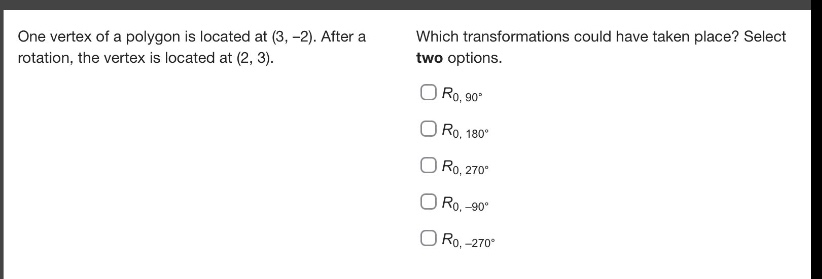
one vertex of a polygon is located at (3, -2). after a rotation, the vertex is located at (2, 3). which transformations could have taken place? select two options. $r_{0,90^{circ}}$ $r_{0,180^{circ}}$ $r_{0,270^{circ}}$ $r_{0,-90^{circ}}$ $r_{0,-270^{circ}}$
Answer
Explanation:
Step1: Recall rotation rules
The rules for rotating a point $(x,y)$ counter - clockwise about the origin $O(0,0)$ are:
- For a $90^{\circ}$ rotation ($R_{0,90^{\circ}}$): $(x,y)\to(-y,x)$
- For a $180^{\circ}$ rotation ($R_{0,180^{\circ}}$): $(x,y)\to(-x,-y)$
- For a $270^{\circ}$ rotation ($R_{0,270^{\circ}}$): $(x,y)\to(y, - x)$
- For a $- 90^{\circ}$ rotation ($R_{0,-90^{\circ}}$): $(x,y)\to(y,-x)$
- For a $-270^{\circ}$ rotation ($R_{0,-270^{\circ}}$): $(x,y)\to(-y,x)$
Step2: Apply rules to the point $(3,-2)$
For $R_{0,90^{\circ}}$: Given $(x = 3,y=-2)$, then $(-y,x)=-(-2),3=(2,3)$ For $R_{0,-270^{\circ}}$: Given $(x = 3,y = - 2)$, then $(-y,x)=-(-2),3=(2,3)$
Answer:
$R_{0,90^{\circ}}$, $R_{0,-270^{\circ}}$